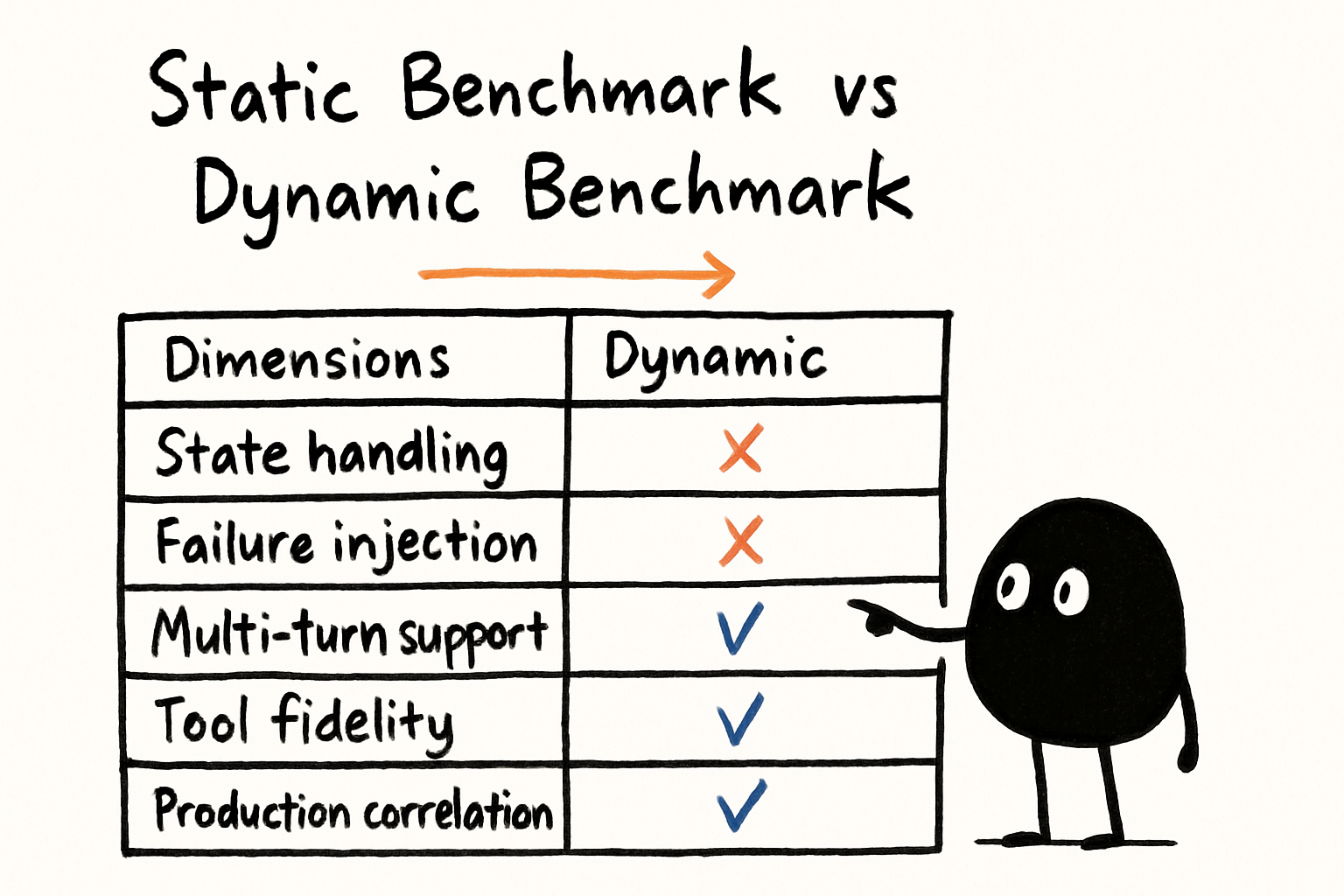
I shipped an agent last quarter that scored 94% on a static evaluation. It failed in production within the first hour. Not a subtle failure — it literally emailed a customer the wrong refund amount, then doubled down when challenged. The benchmark said it was reliable. The benchmark was a lie.
Static benchmarks aren’t just imprecise for AI agents. They’re actively dangerous. They give you a false sense of safety, then let you discover the real failure modes in front of paying customers. Here’s why they fail, and what we should build instead.
The Static Benchmark Fallacy
Most teams still evaluate agents the way they evaluate LLMs: throw a fixed dataset at the system, score the outputs, call it a day. Think MMLU, HumanEval, or any of the canned leaderboards on sites like the LLM Leaderboard 2026. Those measure one-shot knowledge retrieval or code generation against a golden answer. They tell you nothing about whether an agent can navigate a multi-turn conversation, recover from a tool failure, or decide when to escalate.
The problem is structural. Static benchmarks assume the input is known, the output is deterministic, and the evaluation criteria are fixed. An agent in production faces none of those conditions. The user might be angry, the database might be slow, the third-party API might return garbage. Static tests don’t simulate any of that.
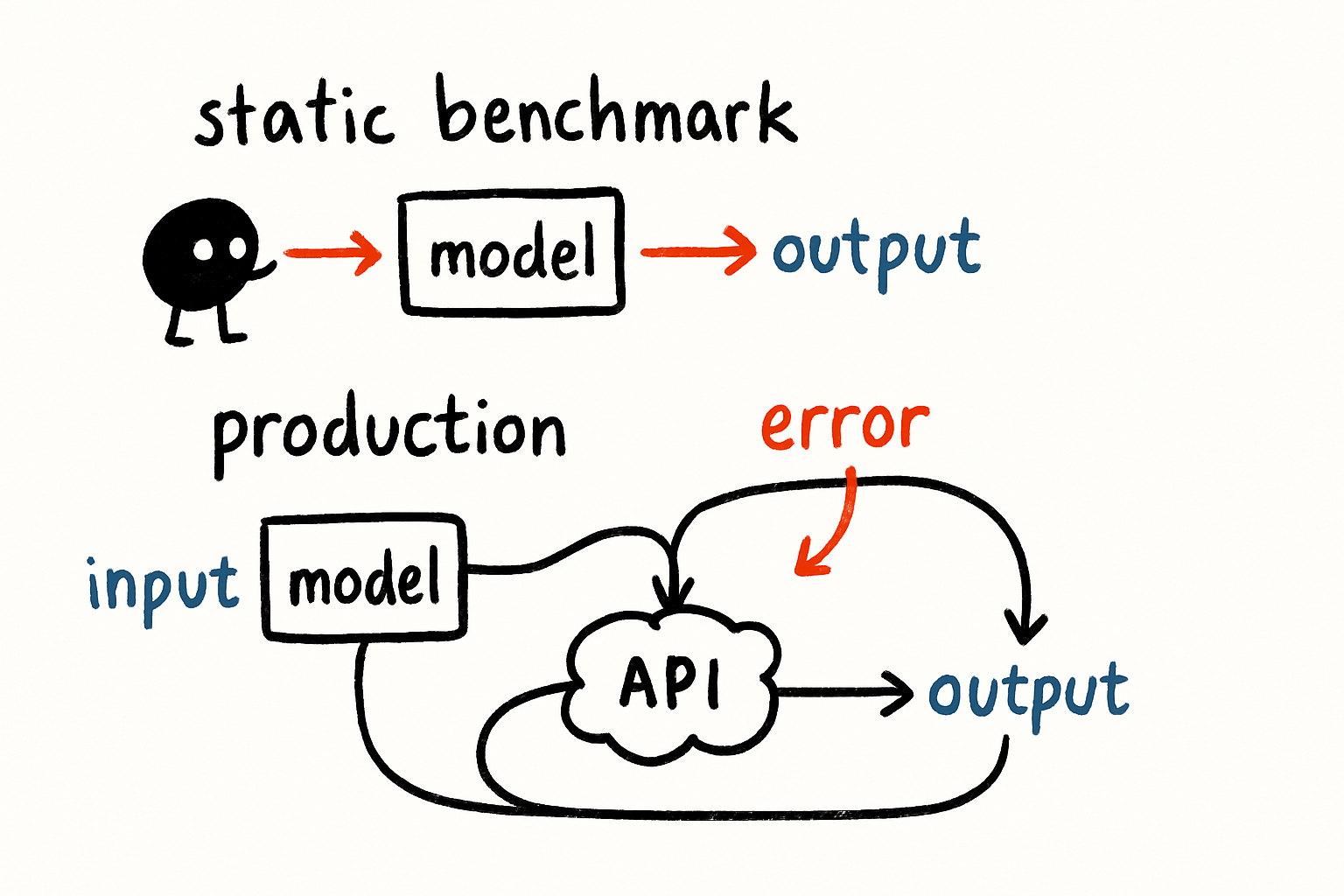
I’ve seen teams ship agents that crushed their internal test suite, only to fail on the first real user who typed something in all caps. The benchmark never tested for tone. The benchmark never tested for anything except whether the final answer matched a pre-written script.
Why Agentic Systems Break Traditional Metrics
Agents are fundamentally different from LLMs because they act. They call APIs, update databases, send emails, and sometimes delete things. A wrong generation in a chatbot is embarrassing. A wrong action in an agent is a liability.
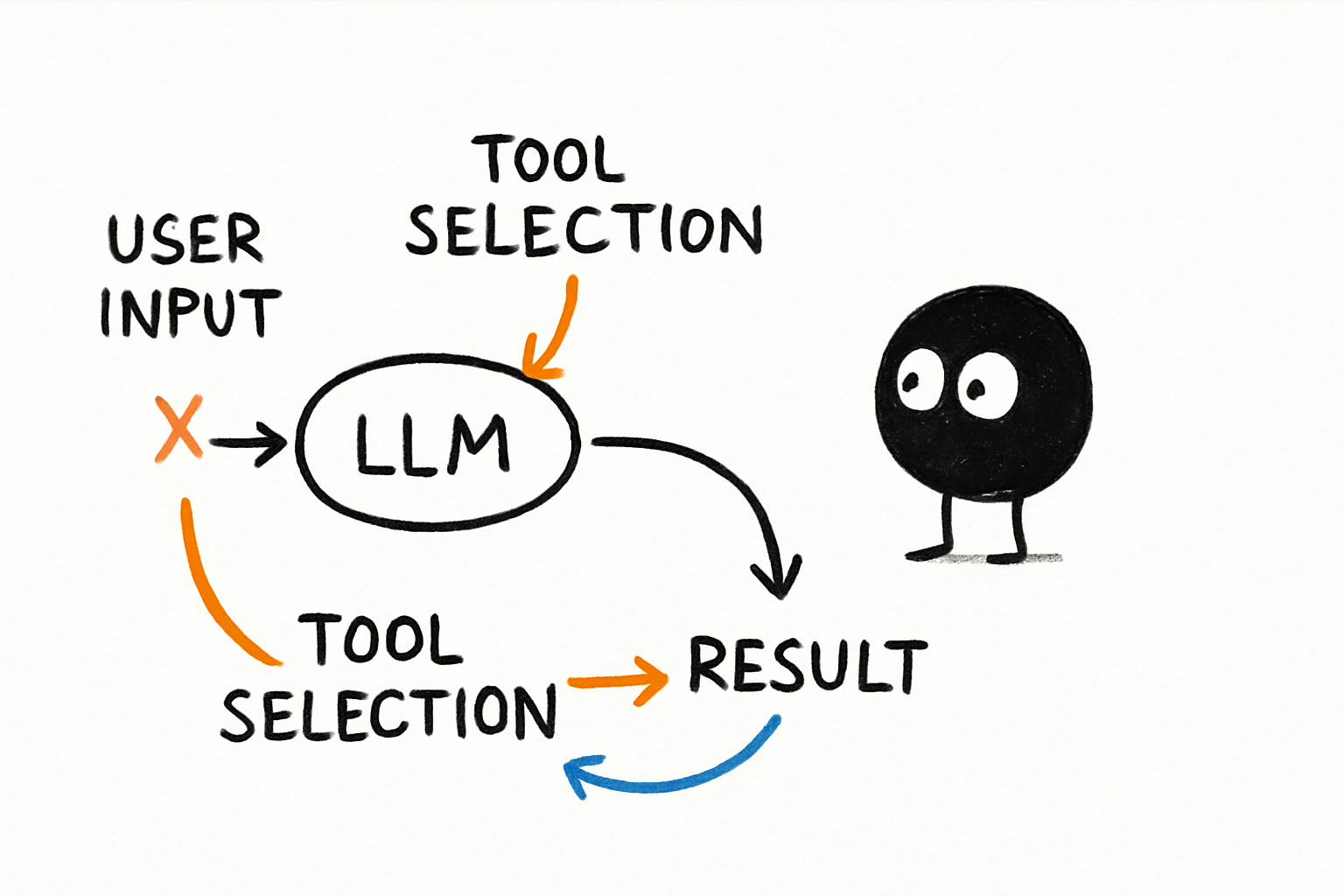
Consider what happens during a single agent loop. The LLM receives a user input, generates a thought, chooses a tool, calls it, gets a result, then decides the next step. At each junction, there’s a failure mode. The tool call might be syntactically correct but semantically wrong — the agent calls get_order_status("12345") when the user asked about order “12346”. Static tests that only check the final output never catch that intermediate misstep.
The research community is starting to acknowledge this gap. A recent survey on LLM benchmarks (arXiv:2508.15361) notes that most existing evaluations “do not capture the interactive and sequential nature of agent tasks.” That’s academic-speak for “your benchmark is useless for agents.”
Another issue: statefulness. A static test resets after each example. Production agents carry context across turns. They remember what they said five messages ago. They might have already sent an email or created a ticket. If the agent hallucinates its own previous action — a common failure mode — no static test will catch it because the test never had a history to begin with.
Key Dimensions for Production Agent Benchmarks
If we’re going to build something useful, we need to measure what actually matters in production. I’ve settled on four dimensions after watching agents fail in the wild for two years.
Task Completion Rate. Did the agent finish what it started? This sounds simple, but it’s not. An agent that “completes” a refund but issues the wrong amount hasn’t really completed the task. You need to verify outcomes against ground truth, not just check if the agent said “done.”
Recovery Grace. When something goes wrong — and it will — does the agent recover gracefully? Can it retry a failed API call with exponential backoff? Can it detect that it gave a wrong answer and correct itself? This is the dimension that kills most agents in production. They either crash silently or double down on a mistake.
Contextual Accuracy. Not just “is the answer correct,” but “is the answer correct given the entire conversation history and the current system state?” An agent that tells a user “your order shipped” when the order was actually cancelled five messages ago has a contextual accuracy problem. Static benchmarks can’t test this because they reset context after each example.
Tool Fidelity. Does the agent call the right tool with the right parameters? This is where most of the dangerous failures live. An agent that calls delete_user_account instead of deactivate_user_account might be passing the final output test, but it’s a production incident waiting to happen.
Each dimension needs its own evaluation strategy. You can’t collapse them into a single score and call it done. That’s what the static benchmarks do, and that’s why they’re useless.
Building a Dynamic Evaluation Pipeline
Here’s what I actually run now. It’s not perfect, but it catches the failures that matter.
First, you need a simulation environment. Not a static dataset — a live, sandboxed world where the agent can act and you can observe the consequences. This means spinning up real API endpoints that return realistic responses, including edge cases like timeouts, malformed data, and authentication errors. The LiveBench project has some good ideas here, though they’re still focused on LLM evaluation rather than full agent loops.
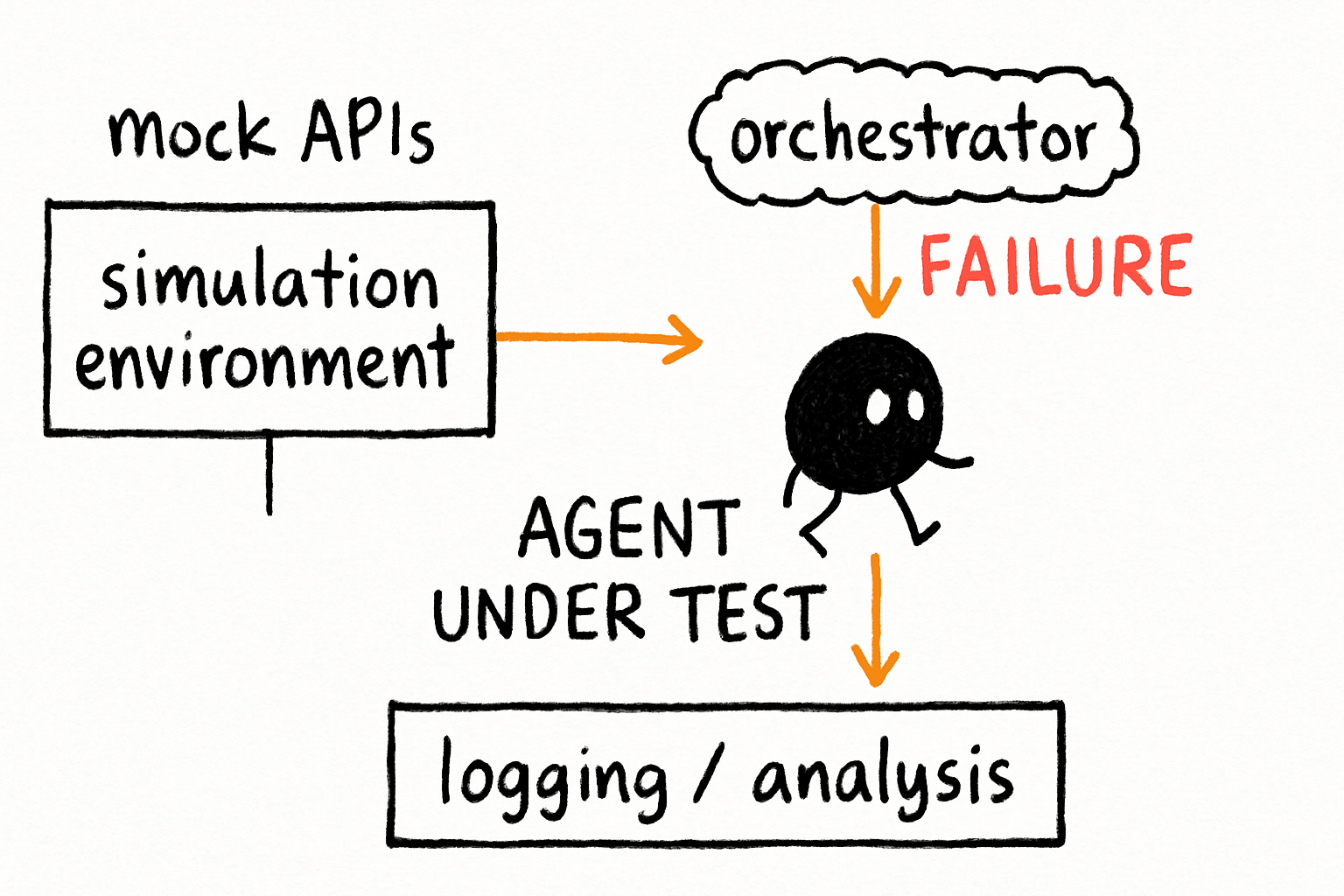
Second, you inject failures deliberately. Don’t test in a clean environment. Test with flaky APIs, slow databases, and adversarial user inputs. I run each evaluation scenario multiple times with different failure patterns. If the agent only works when everything is perfect, it won’t work in production.
Third, you log everything. Every tool call, every LLM generation, every state transition. Then you replay the logs and evaluate not just the final outcome, but each intermediate step. Did the agent make an unnecessary API call? Did it repeat itself? Did it contradict something it said earlier? These are the signals that matter.
Fourth, you automate the evaluation using a judge LLM — but carefully. Don’t ask the judge “is this correct?” Ask specific questions: “Did the agent call the refund tool with a positive amount?” “Did the agent acknowledge the user’s frustration?” Structured evaluation prompts yield structured, reliable results.
A practical note: start with 20 scenarios, not 200. Get the evaluation pipeline working, validate that it catches real failures, then scale up. Most teams overbuild the benchmark and underbuild the simulation environment. The simulation is where the value lives.
Case Study: Benchmarking a Customer Support Agent
I helped a team at a mid-size e-commerce company evaluate their customer support agent. They had a static benchmark with 500 test cases, each with a single user query and a golden answer. The agent scored 96% on that benchmark. They were ready to ship.
We built a dynamic evaluation instead. We created 30 scenarios based on real support tickets from the past six months. Each scenario was a multi-turn conversation with a simulated customer who could get angry, confused, or change their mind. We injected API failures — the order lookup service returned 503 errors on about 20% of calls. We had the agent navigate a real product catalog and a real refund system in a sandboxed environment.
The results were ugly. The agent’s true task completion rate was 63%. It failed on recovery — when the order lookup failed, it often told the user “I can’t find your order” instead of retrying or asking for more information. It had contextual accuracy problems: in one scenario, it confirmed a refund amount, then later contradicted itself because it lost track of the conversation state.
The worst failure: the agent called the refund creation tool with a negative amount. The API accepted it. The sandbox database recorded a negative refund. If that had happened in production, the customer would have been charged instead of refunded. The static benchmark never tested tool parameter validation.
We fixed the issues, rebuilt the evaluation, and eventually shipped an agent that scored 89% on the dynamic benchmark. That agent has been in production for four months with a 94% task completion rate. The difference? We tested for the failures that actually happen.
What’s the main difference between static and dynamic benchmarks for AI agents? Static benchmarks test a model’s ability to produce a correct output from a fixed input. Dynamic benchmarks test an agent’s ability to complete a task in a live environment with state, tool calls, and unpredictable failures. Static benchmarks measure knowledge; dynamic benchmarks measure reliability.
How do you evaluate an agent’s ability to recover from errors in production? You build a simulation environment that deliberately injects failures — API timeouts, malformed responses, authentication errors — and measure whether the agent retries, escalates, or fails gracefully. The key metric is recovery rate: the percentage of failure scenarios where the agent reaches a successful or safe terminal state.
My Take
The industry is cargo-culting LLM evaluation practices onto agent systems, and it’s going to cause real damage. Static benchmarks made sense when we were comparing foundation models on factual recall. They make no sense when we’re deploying systems that can delete data, spend money, or send legally binding communications.
I think the shift to dynamic evaluation is inevitable, but it’s going to be painful. It requires infrastructure that most teams don’t have — sandboxed environments, realistic simulation tools, and evaluation pipelines that can handle multi-turn interactions. The companies that invest in this now will have a massive advantage. The ones that don’t will learn the hard way.
There’s also a cultural problem. Static benchmarks give you a single number you can put on a slide. Dynamic benchmarks give you a distribution of outcomes with failure modes and edge cases. That’s harder to sell to leadership. But it’s the only honest way to evaluate an agent.
Key Takeaways
- Static benchmarks (MMLU, HumanEval, canned datasets) are structurally incapable of evaluating agent behavior because they ignore state, tool calls, and multi-turn interactions.
- The four critical dimensions for agent evaluation are task completion rate, recovery grace, contextual accuracy, and tool fidelity.
- Build a dynamic evaluation pipeline with a simulation environment, deliberate failure injection, full logging, and structured judge LLM prompts.
- Start with 20 realistic scenarios, not 200 canned ones. Validate that your evaluation catches real failures before scaling.
- The agent that scores 96% on a static test and 63% on a dynamic test is not ready for production. The agent that scores 89% on a dynamic test probably is.