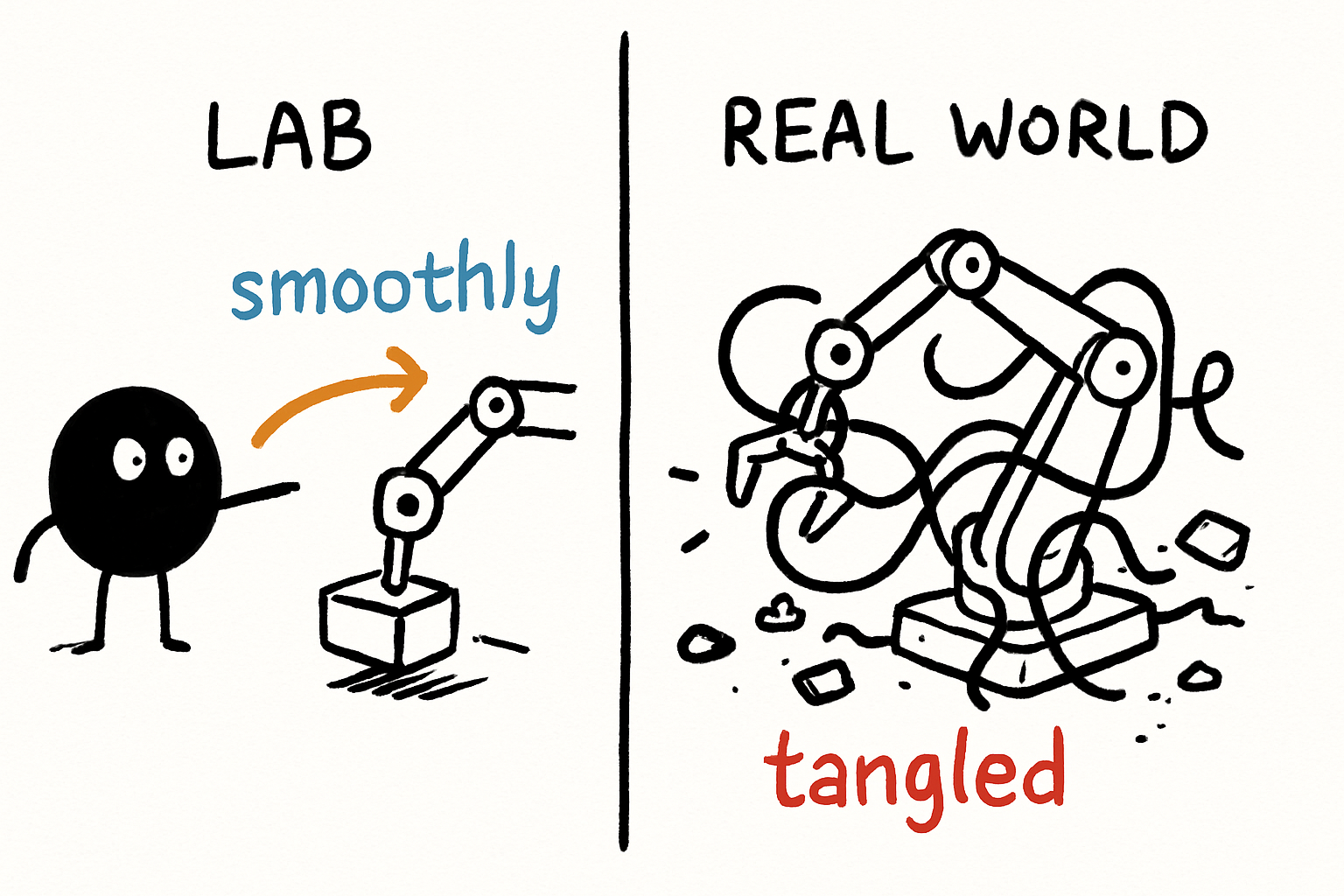
You’ve run your agent through MMLU, HumanEval, and a dozen other static leaderboards. It scores in the 90th percentile. You deploy it to production. Within an hour, it’s hallucinating a customer’s invoice total, getting stuck in a loop trying to confirm a shipping address, and failing to parse a PDF that’s slightly misaligned. This gap—between sanitized test scores and real-world collapse—isn’t a model problem. It’s an infrastructure problem. And LiveBench is the first benchmark that systematically proves it.
The Problem with Static Benchmarks for AI Agents
For the last two years, we’ve been benchmarking AI agents the same way we benchmarked chatbots: throw a static dataset at them, measure accuracy, rank the models. Think MMLU, GSM8K, HumanEval. These are closed-book exams where the questions never change, the context is a single paragraph, and the agent never has to call a tool, recover from an error, or maintain state across ten turns.
Here’s what static benchmarks miss:
- Temporal drift. The real world changes. APIs update. Documentation rots. A static benchmark never tests how an agent handles a service that returns a 503 today when it returned 200 yesterday.
- Multi-step failure cascades. Agents don’t fail on a single step. They fail on step 7 because step 3 returned slightly malformed JSON, and step 4’s error handler had a bug. Static benchmarks don’t model chains of dependencies.
- Context window saturation. Most benchmarks use tiny contexts. Production agents ingest entire codebases, conversation histories, and external APIs. The failure modes of a 128K context window are entirely different from a 4K one.
- Undefined success criteria. What does “success” mean for an agent that’s supposed to book a flight? Is it the cheapest flight? The fastest? The one with the best layover? Static benchmarks define success as a single ground-truth answer, which is a fantasy.
The research community has known about these gaps. A comprehensive survey on LLM benchmarks from ArXiv (2508.15361) explicitly calls out the lack of dynamic, interaction-based evaluation as a critical blind spot. But until LiveBench, we didn’t have a tool that systematically exploited them.
LiveBench: A Stress Test for Agentic AI
LiveBench is an open-source evaluation framework that tests AI agents on tasks that change every two weeks. The questions are generated by a separate LLM, then filtered for ambiguity and ground-truth correctness. No data contamination. No memorization. Every two weeks, the test set is entirely new.
But the real innovation isn’t the freshness of the questions. It’s the structure of the tasks. LiveBench evaluates agents on:
- Multi-turn reasoning. Can the agent maintain coherent state across a conversation that spans 20+ turns, where each turn depends on information from turns 1 and 12?
- Tool use with real APIs. The agent must call live services—weather APIs, search engines, database queries—and handle success, failure, and timeout responses.
- Instruction following under ambiguity. The prompt is deliberately underspecified. The agent must ask clarifying questions or make reasonable assumptions.
- Grounding in retrieved context. The agent is given a long document and must answer questions that require synthesizing information from multiple sections, not just pattern-matching a single sentence.
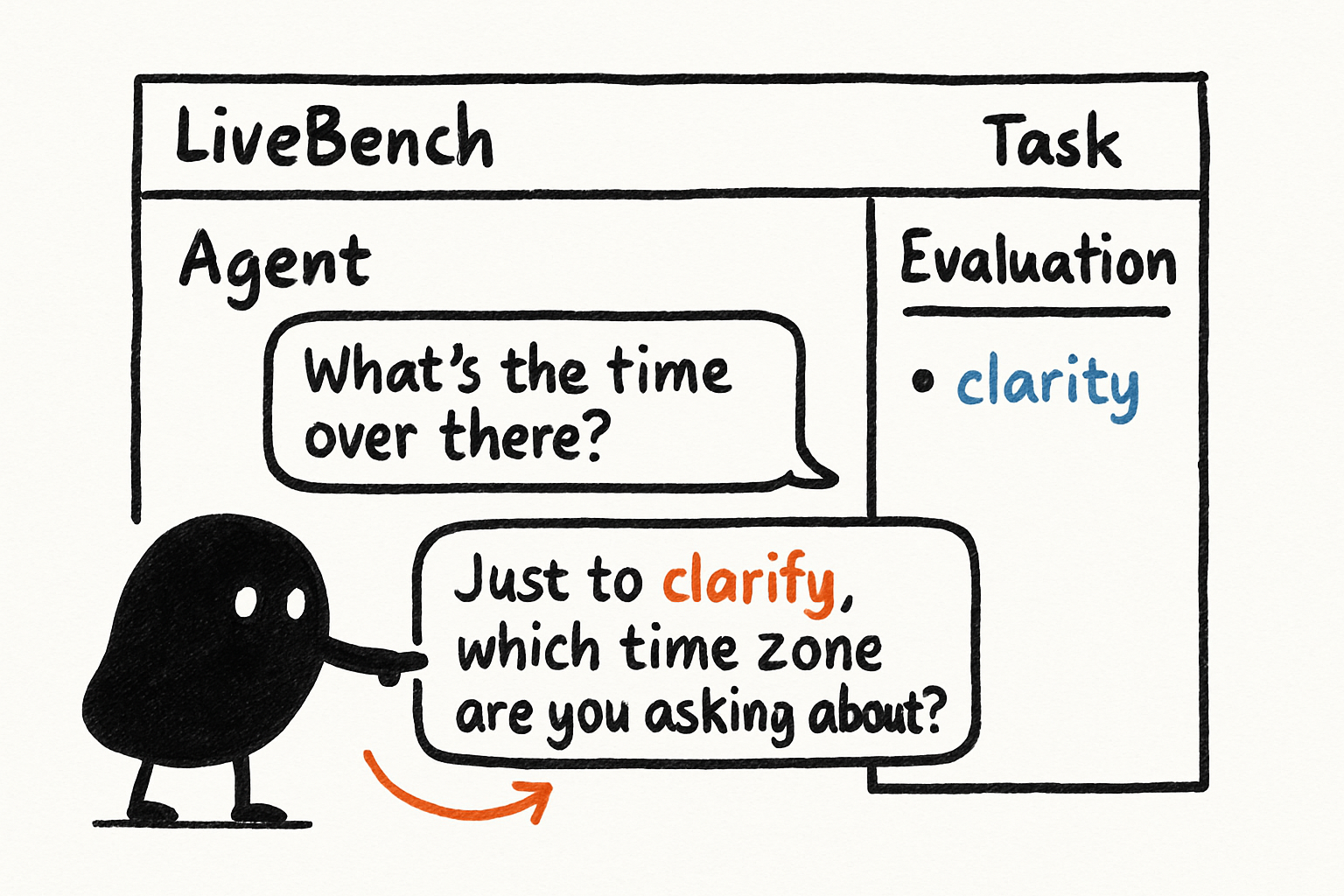
The results are sobering. According to the LiveBench leaderboard, even top-tier models like GPT-4o and Claude 3.5 Sonnet see a 15-25% drop in accuracy compared to their static benchmark scores. The gap is largest on tasks that require multi-step tool use and recovery from unexpected API responses.
Q: How does LiveBench differ from traditional benchmarks like MMLU or HumanEval? A: LiveBench tests agents on dynamic, real-world tasks that change every two weeks, including multi-turn reasoning, live API calls, and ambiguous instructions. Traditional benchmarks use fixed datasets with single-step, well-defined questions that allow models to memorize patterns. LiveBench reveals failure modes static benchmarks cannot detect.
Key Fragilities Exposed by LiveBench
After running dozens of agentic systems through LiveBench, three categories of failure consistently emerge. These aren’t edge cases. They’re the norm.
Fragility 1: Context Window Mismanagement
Agents routinely lose track of information. They’ll correctly answer a question about a document’s main topic, then fail a follow-up question that requires remembering a specific number from paragraph 12. The root cause is almost always context window management: the agent either truncates relevant information, or it fails to retrieve it from a vector store when needed.
LiveBench tests this explicitly with tasks that require synthesizing information from a 50-page document. The best agents still hallucinate details from the document they just read. The problem isn’t the model’s comprehension. It’s the infrastructure that feeds it context.
Fragility 2: Tool Call Error Handling
This is the biggest killer. Agents call an API, get a 429 rate-limit error, and either retry indefinitely or give up entirely. They don’t exponential backoff. They don’t fall back to a cached result. They don’t ask the user for guidance. They just… fail.
In one LiveBench task, an agent was asked to “get today’s weather in London and then find a restaurant near the location.” The weather API returned a 503. The agent retried three times, got three 503s, and then declared the task impossible. A human would have waited 30 seconds and retried, or used a different weather service. The agent had no concept of transient failure.
Fragility 3: Loop Detection and Termination
Agent loops are the silent killer of production deployments. An agent gets into a cycle: call tool A, get result, call tool B, get error, call tool A again, get result, call tool B again, get error. It can run for hours, burning tokens and API credits, without ever terminating.
LiveBench includes tasks specifically designed to trigger loops—tasks where the correct answer requires the agent to recognize that a tool is unavailable and either ask the user or use a different strategy. Most agents fail. They don’t have a built-in loop detector. They don’t have a max-retry policy. They don’t have a way to say “I’m stuck, help me.”
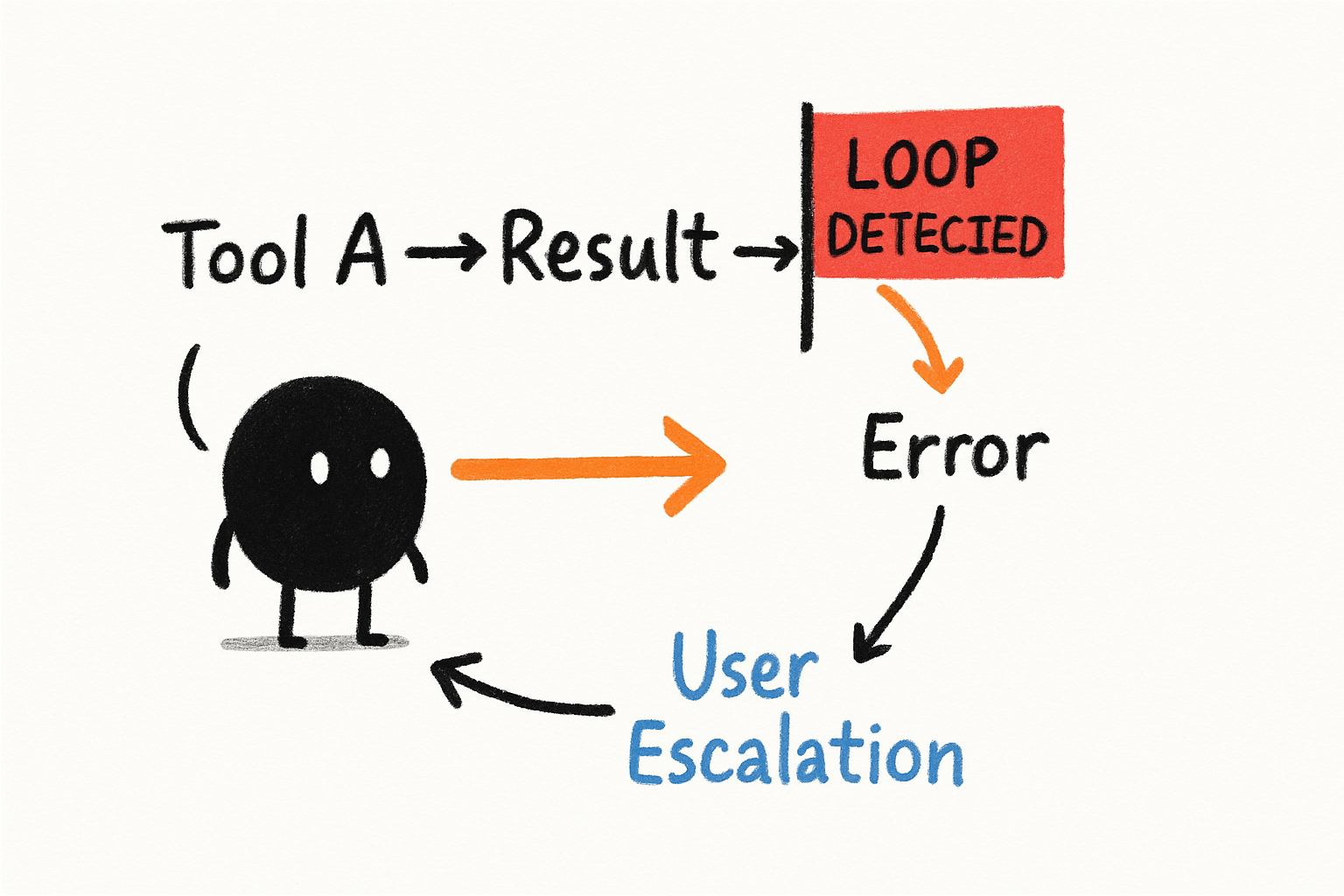
Q: What is the most common cause of failure for AI agents in production? A: The most common cause is poor error handling during tool calls, specifically the inability to handle transient errors like rate limits or service outages. Agents either retry indefinitely or give up entirely, without implementing exponential backoff, caching, or user escalation.
Why These Failures Are Infrastructure, Not Model, Problems
It’s tempting to blame the model. “GPT-4o isn’t smart enough.” “Claude can’t reason about tool outputs.” But that’s wrong. The same model that fails on LiveBench can succeed when given the right infrastructure scaffolding.
Consider the loop detection problem. A model’s architecture doesn’t have a built-in loop counter. It doesn’t have a concept of time. It generates tokens based on the immediate context. If you give it a prompt that says “You have tried tool B three times. It keeps failing. What do you do?” it will likely say “I should try a different approach.” But the model doesn’t generate that prompt itself. The infrastructure must inject that meta-instruction.
This is the core insight of agentic AI infrastructure: the model is the reasoning engine, but the infrastructure is the operating system. The OS handles memory management, process scheduling, error handling, and resource allocation. If the OS is buggy, the application crashes, no matter how good the CPU is.
Nvidia’s recent push into agentic AI infrastructure—announced at their GTC conference and covered by CIO—is a recognition of this. They’re building tools for orchestration, observability, and guardrails. They know that the model alone isn’t enough.
How Context Engineering Addresses LiveBench’s Findings
Context engineering is the practice of designing, structuring, and maintaining the context window to maximize an agent’s reliability. It’s not prompt engineering. Prompt engineering is about writing better instructions. Context engineering is about building a system that dynamically manages what information is available to the model, when, and in what format.
Here’s how context engineering directly addresses LiveBench’s findings:
- For context window mismanagement: Implement a tiered context system. The most recent and most relevant information goes into the model’s active context window. Older information is stored in a vector store with a retrieval-augmented generation (RAG) layer that the model can query explicitly. This prevents the model from losing track of information it needs later.
- For tool call error handling: Inject a “tool call protocol” into the system prompt. This protocol defines retry policies (exponential backoff, max 3 retries), fallback strategies (use cached results, try alternative API), and escalation paths (ask user, log error). The model doesn’t invent this behavior. The infrastructure enforces it.
- For loop detection: Build a loop detector as a separate service that monitors the agent’s action history. If it detects a repeating pattern (same tool, same parameters, same error), it terminates the loop, logs the incident, and either returns a fallback response or escalates to a human. The model never sees the loop detector. It just gets a new instruction: “You were stuck in a loop. Here’s the state. Continue from here.”
The key principle is that the model should never be responsible for its own infrastructure. The model reasons. The infrastructure manages.
Practical Steps to Harden Your Agentic Stack
If you’re deploying agents today, here’s what I recommend based on what LiveBench reveals.
Step 1: Implement a Context Budget
Don’t let the model fill the context window arbitrarily. Set a hard limit—say, 32K tokens for active context—and move everything else to a RAG layer. Monitor the context fill rate. If the agent is approaching the limit, force a summarization step or evict the oldest turns.
Step 2: Add a Tool Call Middleware
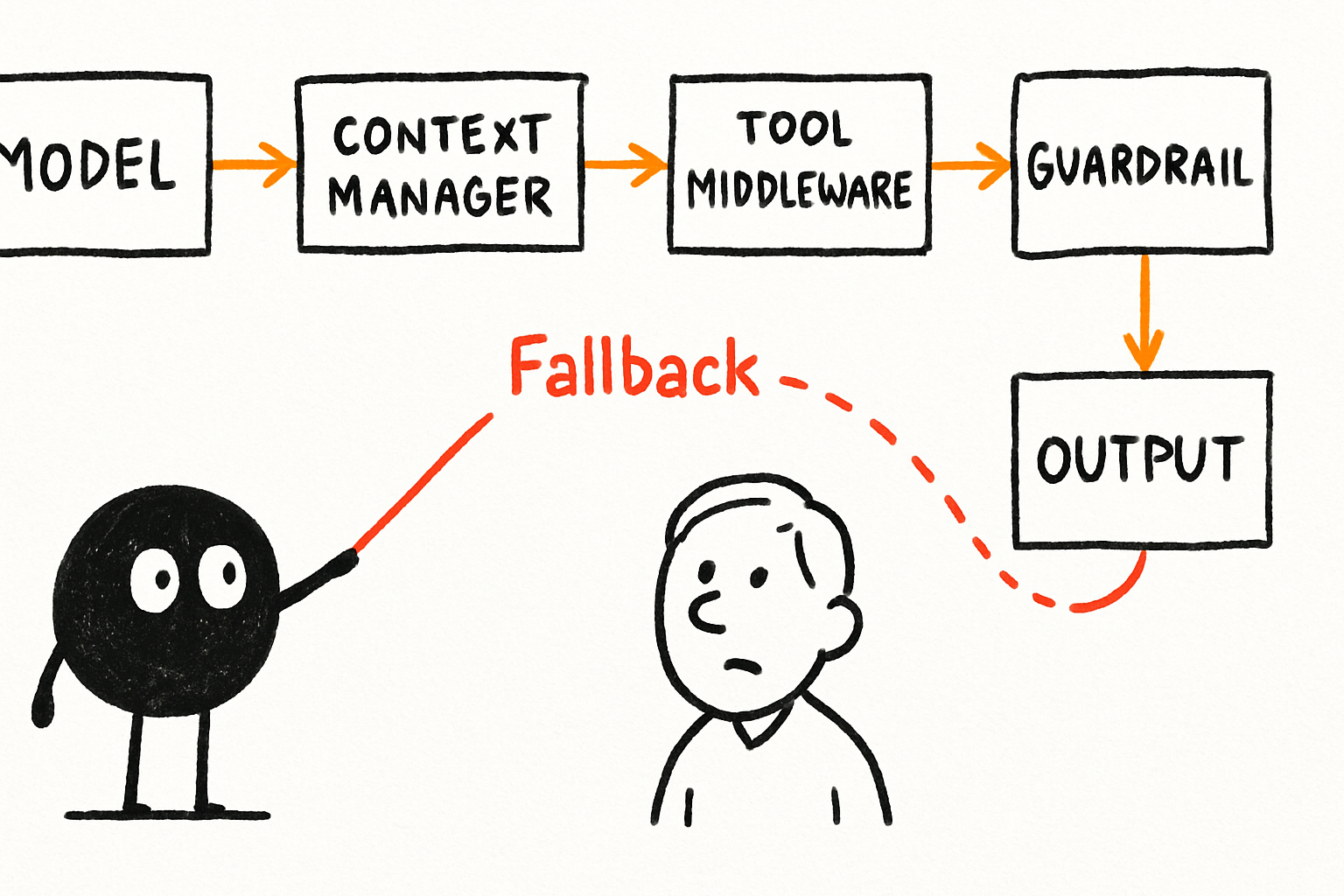
Every tool call should go through a middleware layer that handles retries, caching, and error transformation. This middleware is invisible to the model. It intercepts the raw API response, applies the retry policy, and returns a clean success or failure to the model. The model never sees a 503. It sees “Weather API unavailable. Retry in 30 seconds.”
Step 3: Build a Loop Detector
This is a simple service that watches the agent’s action stream. If it sees three consecutive identical tool calls with identical parameters and identical results, it raises a flag. The agent is paused, the loop is broken, and a fallback handler takes over. This prevents runaway token costs and infinite loops.
Step 4: Inject System-Level Guardrails
Don’t rely on the model to follow instructions. Enforce them at the infrastructure level. If the agent is supposed to stay within a certain scope, use a guardrail service that checks every output against a policy. If the output violates the policy, the guardrail blocks it and returns a safe default.
My Take
I’ve been building agentic systems for three years. I’ve seen the same pattern repeat: a team spends months fine-tuning a model, gets great benchmark scores, deploys it, and watches it fail within days. They blame the model. They spend more months fine-tuning. It still fails.
LiveBench is the first benchmark that tells you the truth: the model isn’t the bottleneck. The infrastructure is. The fragility isn’t in the reasoning engine. It’s in the context management, the error handling, and the loop detection.
The fix isn’t a better model. It’s context engineering. It’s building an operating system for your agent that handles memory, errors, and loops the same way your laptop handles processes, crashes, and deadlocks. Until we treat agentic AI as an infrastructure problem, we’ll keep building agents that ace the exam and fail the job.
Key takeaways
- Static benchmarks like MMLU and HumanEval miss multi-step failures, context saturation, and temporal drift that cause real-world agent crashes.
- LiveBench tests agents on dynamic, real-world tasks with live APIs and ambiguous instructions, revealing a 15-25% accuracy drop vs. static benchmarks.
- The top three failures are context window mismanagement, poor tool-call error handling, and inability to detect and break agent loops.
- These are infrastructure problems, not model problems. The model reasons; the infrastructure manages memory, errors, and loops.
- Context engineering—designing the context window and tool-call middleware—is the only viable fix for agentic AI infrastructure fragility.
- Practical hardening steps: set a context budget, add tool-call middleware, build a loop detector, and inject system-level guardrails.