I just spent a week integrating a new model release into an agent pipeline. By Friday, a different model had topped the leaderboard, the API pricing had shifted, and a third vendor had shipped a feature that made my carefully tuned prompts behave differently. This is not a complaint. This is the new reality of production AI engineering, and if your agent infrastructure is tied to a single model, you are already behind.
The pace of model releases is not accelerating in a linear fashion. It is compounding. In the last six months alone, the number of commercially viable LLMs has more than tripled, with new architectures, context windows, and reasoning capabilities shipping weekly. The window between a model launch and its obsolescence is shrinking to months, sometimes weeks. For teams building agentic systems that need to operate reliably in production, this creates a fundamental tension: you need stability, but the ecosystem demands constant adaptation.
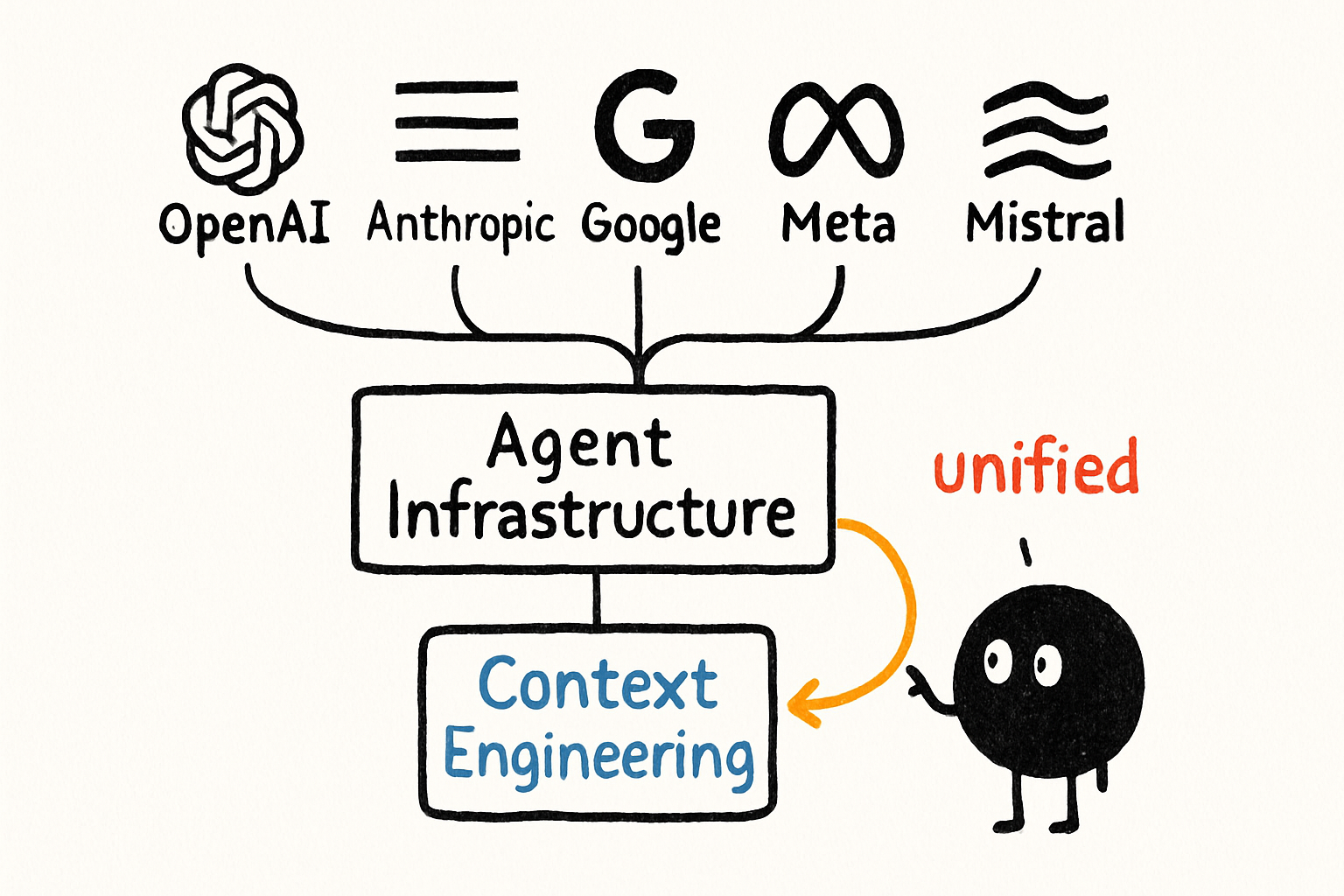
The only sane response is to decouple your agent infrastructure from any specific model. That means building a model-agnostic agent infrastructure where the model is a pluggable component, not the foundation. And the critical enabler for this decoupling is not a new framework or a clever caching layer. It is context engineering.
The Model Release Deluge: Why This Time Is Different
We have seen rapid iteration before. The shift from GPT-3 to GPT-3.5 was dramatic. The jump from GPT-3.5 to GPT-4 was transformative. But those were singular events, spaced months apart. What we are seeing now is different in kind, not just degree.
Consider the data. The AI Model Release Tracker from Evertune logs over 200 distinct model releases in the past twelve months, with the pace accelerating through Q2 and Q3 of this year. We are not talking about minor version bumps. We are talking about entirely new architectures: Mixture of Experts models from multiple vendors, state-space models challenging the transformer paradigm, and specialized reasoning models that use chain-of-thought internally.
TechCrunch’s AI coverage has shifted from reporting on individual model launches to publishing weekly roundups of releases you might have missed. A single week in September included a new reasoning model from OpenAI, a vision-language update from Google, a fine-tuned specialist model from a European startup, and an open-weight release from a Chinese lab. That is not a trickle. That is a deluge.
The implications for agent systems are severe. An agent workflow is not a single API call. It is a sequence of decisions, tool calls, and context-dependent reasoning steps. If the underlying model changes its behavior mid-conversation, or if you swap models between planning and execution phases, the entire system can destabilize. You cannot treat model churn as a deployment detail. It is a systems architecture problem.
The Hidden Cost of Model Churn in Agentic Workflows
Most teams think about model churn in terms of retraining prompts or adjusting hyperparameters. That is the visible cost. The hidden costs are much more dangerous.
First, there is behavioral drift. Two models that score identically on standard benchmarks can behave completely differently in an agentic loop. The Vellum LLM Leaderboard shows that GPT-4o and Claude 3.5 Sonnet are within 2% of each other on general reasoning benchmarks. But in practice, one is significantly better at following multi-step instructions, while the other excels at structured output generation. If your agent pipeline was tuned for the strengths of one model, switching to the other without re-engineering the context structure will break the workflow.
Second, there is the cost of revalidation. Every time you swap a model, you need to re-run your entire agent evaluation suite. For complex agent systems, that suite can take hours or days. The survey on LLM benchmarks from arXiv shows that even standardized benchmarks suffer from contamination and saturation issues. Custom evaluations for agentic behavior are even more fragile. The more tightly coupled your infrastructure is to a specific model, the more revalidation work you create with each release.
Third, there is opportunity cost. When a new model ships with a killer feature — say, a 200K context window or native function calling — you want to adopt it quickly. But if your infrastructure requires weeks of integration work, you miss the window. The teams that can adopt new models in days, not months, gain a compounding advantage.
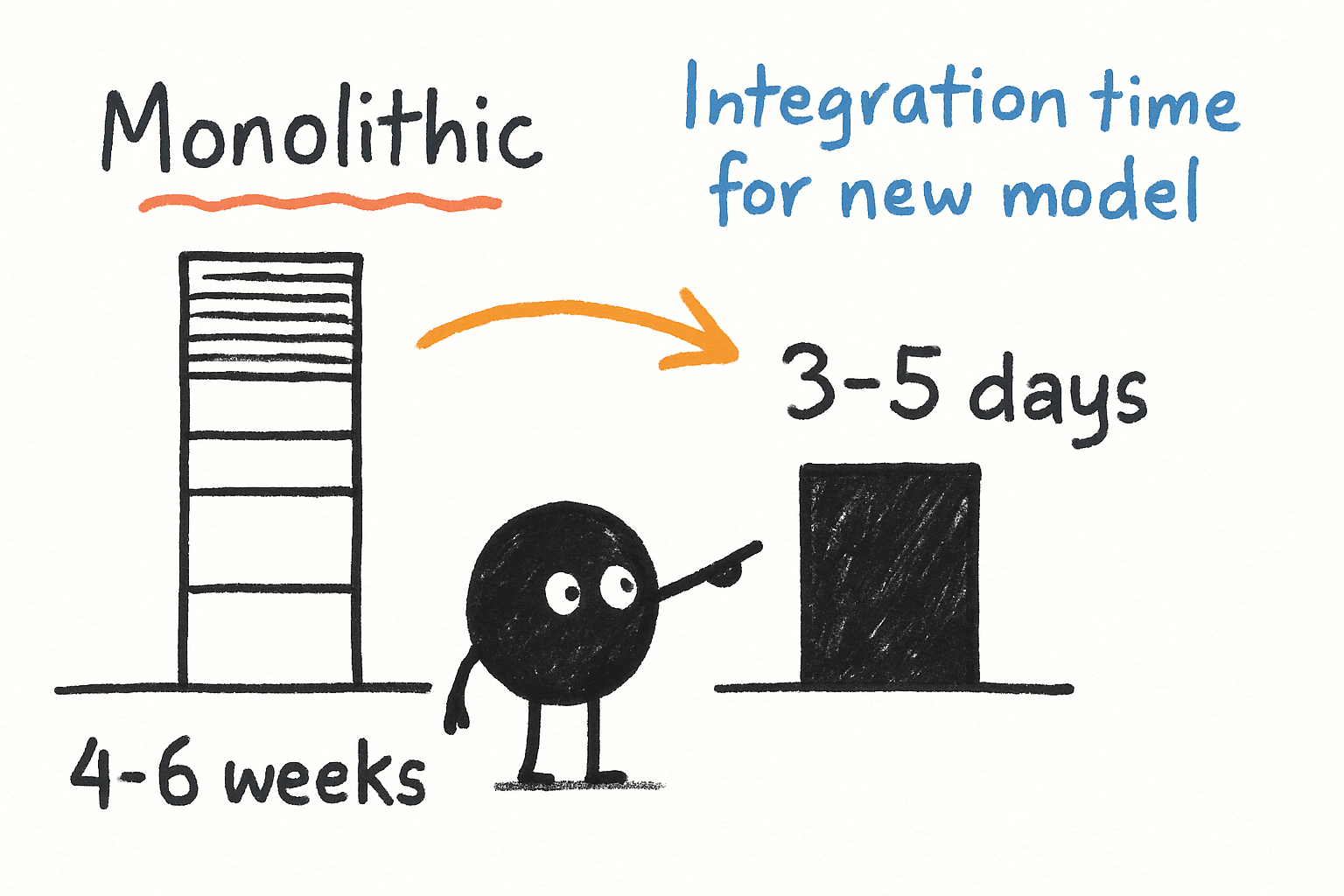
What is the biggest hidden cost of model churn in agent systems? The biggest hidden cost is behavioral drift that breaks your agent’s decision-making loops. Two models with identical benchmark scores can behave completely differently in practice, forcing revalidation of every agent workflow. This revalidation time compounds with each new model release.
Model-Agnostic Infrastructure: The Architectural Shift Required
Building a model-agnostic agent infrastructure means treating the model as a replaceable component, not the core of your system. This requires three architectural shifts.
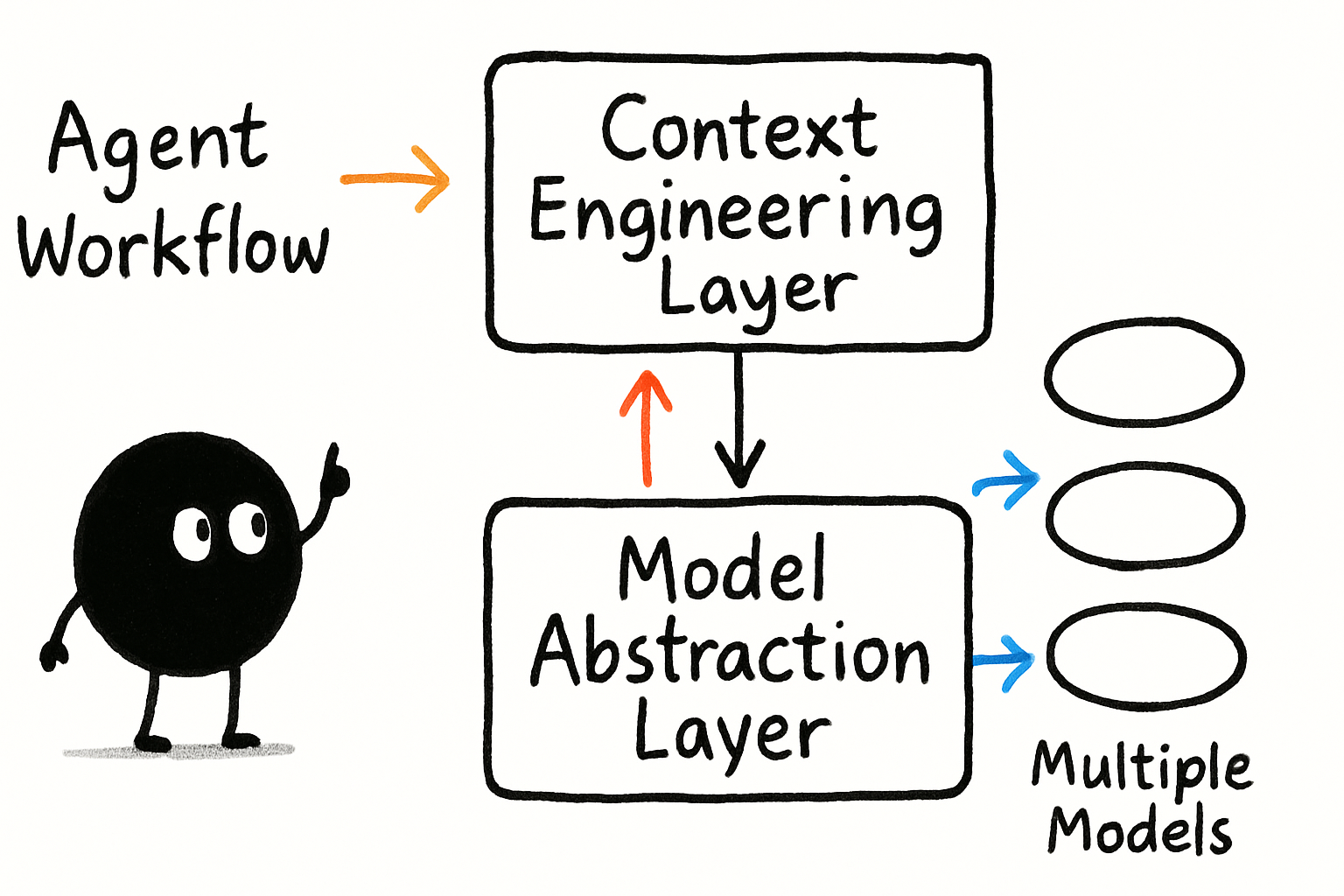
Shift one: Abstract the model interface. Your agent should never call an API directly. Instead, it should call an abstraction layer that normalizes inputs and outputs across models. This layer handles tokenization differences, context window limits, and response format variations. Think of it like an ORM for databases, but for LLMs. The abstraction layer translates your agent’s intent into whatever format the underlying model expects, then normalizes the response back into your system’s standard representation.
Shift two: Separate planning from execution. Agentic workflows typically have two phases: planning (deciding what to do) and execution (doing it). These phases benefit from different model characteristics. Planning needs strong reasoning and instruction following. Execution needs speed and reliability. A model-agnostic infrastructure lets you route planning to a powerful reasoning model like GPT-4o or Claude Opus, while routing execution calls to a faster, cheaper model like GPT-4o mini or Claude Haiku. This is not just an optimization. It is a robustness strategy. If one model fails or degrades, you can reroute without re-architecting.
Shift three: Make context the invariant. This is the most important shift. In a model-agnostic system, the model changes but the context structure does not. Your context engineering layer becomes the stable foundation that all models plug into. This is what makes the whole approach viable.
How do you separate planning from execution in an agent system? You build two separate pipelines with different model requirements. The planning pipeline uses a strong reasoning model to decompose tasks into steps. The execution pipeline uses a faster, cheaper model to run those steps. A model-agnostic infrastructure lets you swap models independently in each pipeline without breaking the overall workflow.
Context Engineering as the Glue for Model Independence
Context engineering is the practice of designing, structuring, and maintaining the context that an LLM operates on. It is not the same as prompt engineering. Prompt engineering is about crafting the right instruction. Context engineering is about building the entire information environment that the model sees: system prompts, conversation history, retrieved documents, tool definitions, and output constraints.
In a model-agnostic agent infrastructure, context engineering becomes the invariant. Here is why.
Different models have different sensitivities to context structure. Some models perform better with explicit system prompts. Others ignore system prompts and prefer in-context examples. Some models handle long conversation histories well. Others degrade significantly after a few turns. If you hard-code your context structure for one model, you lose the ability to swap models cleanly.
The solution is to build a context engineering layer that normalizes how context is constructed and delivered, regardless of the underlying model. This layer does three things:
-
Context templating. You define your agent’s context in a model-agnostic format. The layer then translates that template into the optimal format for each model. For models that excel with system prompts, it uses a system prompt. For models that prefer in-context examples, it renders the same information as few-shot examples. The content is identical. The structure adapts.
-
Context window management. Different models have different context windows, and they degrade differently as the window fills. Your context engineering layer tracks token usage per model and dynamically adjusts the context strategy. It might truncate history for one model while preserving full context for another. It might use different summarization strategies depending on the model’s attention characteristics.
-
Tool definition normalization. Agent systems rely on tool definitions. Different models expect tool definitions in different formats. OpenAI uses JSON schemas. Anthropic prefers structured descriptions. Google uses function declarations. Your context engineering layer normalizes these into a canonical format internally, then renders them into each model’s expected format at the boundary.
This approach is documented in practice by teams at companies like Alan, who published their benchmarking methodology on Medium. Their work shows that context structure significantly impacts model performance, and that the optimal context structure varies by model family. A model-agnostic context engineering layer lets you exploit these differences without hard-coding for any single model.
Practical Steps to Build Model-Agnostic Agent Stacks Today
You do not need to rewrite your entire stack overnight. Here are five steps you can take this week to start moving toward model-agnostic agent infrastructure.
Step one: Audit your model dependencies. Go through your agent code and identify every place where you directly call a model API or reference a model-specific feature. You will likely find these dependencies scattered across planning logic, tool execution, and output parsing. Document them all. You cannot decouple what you have not mapped.
Step two: Build a thin abstraction layer. Start with a simple Python class or TypeScript interface that wraps model API calls. Define a standard input format (system prompt, conversation history, tool definitions) and a standard output format (response text, tool calls, usage metrics). Implement wrappers for your primary models. This does not need to be perfect. It just needs to exist.
Step three: Normalize your context structure. Take your most stable agent workflow and define its context template in a model-agnostic format. Use a JSON schema or a configuration file that describes the context independent of any model. Then implement renderers that translate this template into the format each model expects. Test the same agent workflow across two different models using the normalized context.
Step four: Implement model selection logic. Build a simple routing layer that selects which model to use for which agent task. Start with a rules-based approach: planning tasks go to model A, execution tasks go to model B. As you gather data, you can evolve this into a more sophisticated selector that considers latency, cost, and task complexity.
Step five: Set up continuous model evaluation. Create a regression test suite for your agent workflows. Run it every time a new model release happens, or at least weekly. The key is to track not just pass/fail rates, but behavioral metrics: how many turns does the agent take? How often does it call tools unnecessarily? How consistent is its output format? Over time, this data will inform your model selection strategy.
Nvidia’s recent push into agentic AI infrastructure, as reported by CIO, signals that the industry is moving in this direction. They are building frameworks that treat models as interchangeable components within larger agent systems. The same logic applies at the application level.
My take
The industry is making a mistake by fetishizing model capabilities while ignoring infrastructure. Every week there is a new benchmark, a new leaderboard, a new “GPT-4 killer.” But benchmarks measure isolated capabilities, not system reliability. An agent system that works perfectly with one model and breaks with another is not a robust system. It is a fragile prototype.
The teams I see succeeding in production are the ones that treat models as commodities. They evaluate models ruthlessly, swap them frequently, and invest their engineering effort in the infrastructure that makes model independence possible. The teams that struggle are the ones that bet their entire architecture on a single model’s unique capabilities, then panic when the model changes or a better one appears.
Context engineering is the leverage point. If you get the context layer right, you can swap models in hours, not weeks. If you get it wrong, you are locked into whatever model you started with, and you will be fighting behavioral drift forever.
The next twelve months will see more model releases than the previous three years combined. The teams that build model-agnostic infrastructure now will be the ones shipping production agent systems a year from now. Everyone else will be stuck in a permanent cycle of integration, revalidation, and catch-up.
Key takeaways
- The pace of model releases is compounding, with hundreds of commercially viable models shipping annually. Tying agent infrastructure to any single model is a strategic liability.
- Model churn in agentic workflows creates hidden costs: behavioral drift, revalidation overhead, and missed adoption windows for new capabilities.
- Model-agnostic agent infrastructure requires three architectural shifts: abstracting the model interface, separating planning from execution, and making context the invariant.
- Context engineering is the key enabler for model independence. A normalized context layer lets you swap models without re-engineering agent workflows.
- Start today by auditing model dependencies, building a thin abstraction layer, normalizing context structure, implementing model selection logic, and setting up continuous evaluation.
- The teams that treat models as commodities and invest in infrastructure will dominate production agent deployment in the coming year.