You check the leaderboard on Monday. Claude Sonnet 5 is top for coding. By Wednesday, Gemini 2.5 Ultra edges it out on reasoning. By Friday, a fine-tuned Llama 4 variant nobody saw coming beats them both on the MATH benchmark. This is not a bug in the industry. It is the defining feature. The pace of AI model releases is a firehose, and if your infrastructure is bolted to a single provider or a specific model architecture, you are not building for the future — you are building a monument to last week’s leaderboard.
The real cost is not the API bill. It is the hidden technical debt of model-specific glue code, brittle prompt templates, and agentic systems that collapse when you swap the brain. The only durable solution is model-agnostic AI infrastructure, and the engineering pattern that makes it possible is context engineering.
H2: The Model Release Firehose Is Not Slowing Down
We are past the point where a human can track every significant model release manually. According to the AI Model Release Tracker from Evertune, the cadence of new models, fine-tunes, and major version bumps has accelerated to multiple per week. The LLM Leaderboard 2026 shows the top slot changing hands every few weeks, with performance deltas shrinking but specialization increasing. One week, a model dominates agentic tool use. The next, a different model crushes multilingual retrieval.
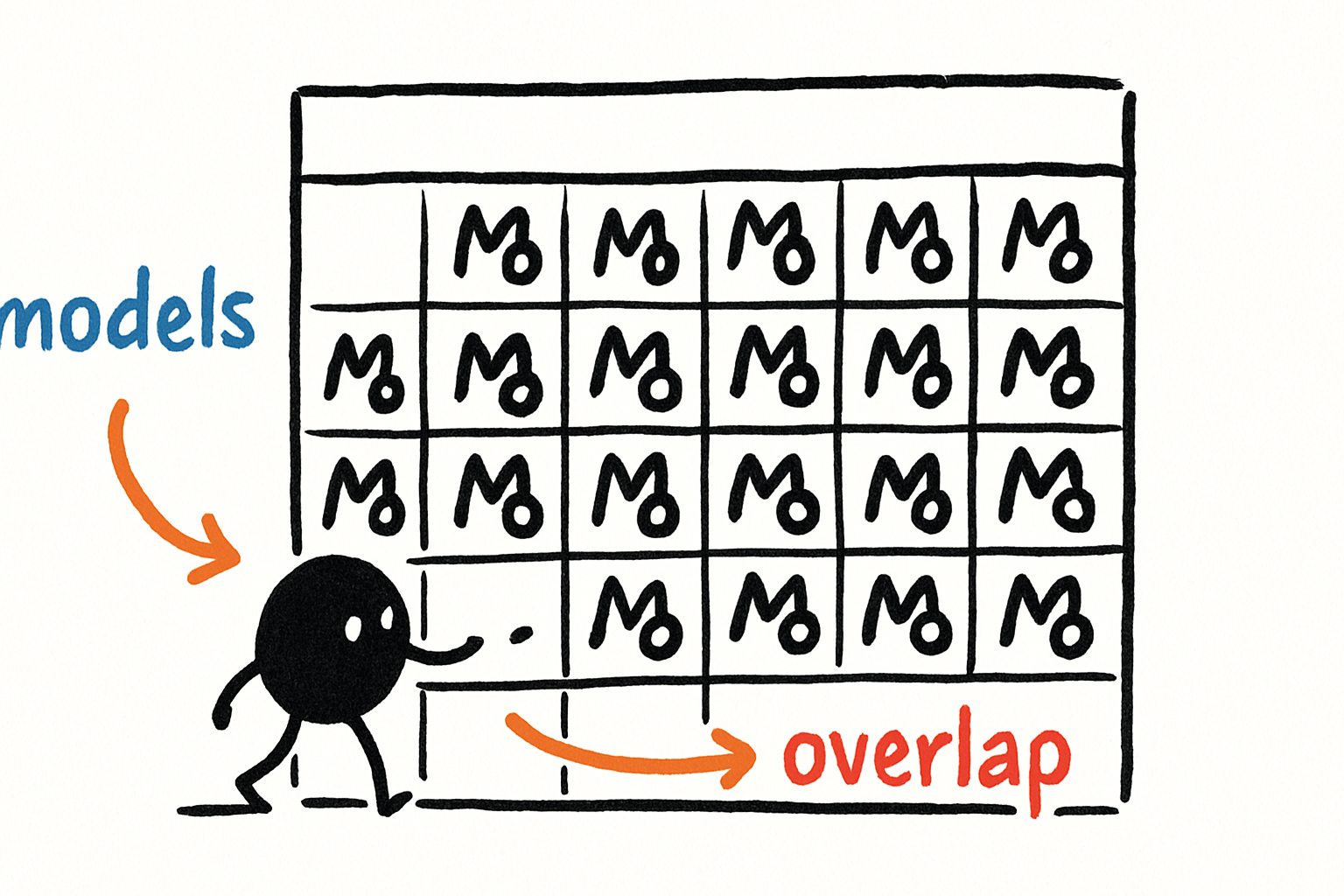
This is not a temporary hype cycle. The underlying economics — cheaper compute, better architectures, open-weight releases from global labs — guarantee the trend continues. If you are building a production system today that depends on a single model’s quirks, you are making a bet that the rate of change will slow. That bet has already lost.
Why does the pace of model releases matter for my infrastructure? It matters because every new model introduces subtle shifts in output formatting, reasoning style, and tool-calling behavior. An infrastructure designed to handle one specific model will break or degrade with each release, requiring constant manual patching. A model-agnostic infrastructure absorbs these shifts automatically, letting you swap models without rewriting your system.
H2: Why Model-Specific Infrastructure Creates Hidden Technical Debt
The obvious cost is the API migration. You have to update the endpoint, the authentication, the rate limiting. That is the easy part. The real debt accumulates in three places.
First, prompt engineering becomes a liability. You craft a prompt that works perfectly with GPT-4o’s instruction following. It uses specific phrasing, few-shot examples tuned to its token distribution, and system prompts that exploit its particular attention patterns. Then you switch to Claude 3.5 Sonnet. The tone is off. The output format shifts. The chain-of-thought reasoning collapses. You spend a week re-tuning. Then you switch again. This is not engineering. It is whack-a-mole.
Second, agentic tool-calling logic is deeply coupled to model behavior. An agent that decides which tool to call based on how a specific model formats its “thinking” block will fail when the next model uses a different internal structure. I have seen production agent loops that parse JSON from a model’s response by counting brackets — and break when a new model adds a trailing whitespace character. That is not robust. That is a house of cards.
Third, evaluation pipelines become stale. You benchmark against a specific model’s outputs, then the model gets deprecated or a new version changes its distribution. Your evals no longer measure system performance; they measure how much your system still matches the old model’s quirks. The survey on large language model benchmarks highlights a critical point: benchmarks themselves are moving targets, and systems optimized for one benchmark-model pair often fail to generalize.
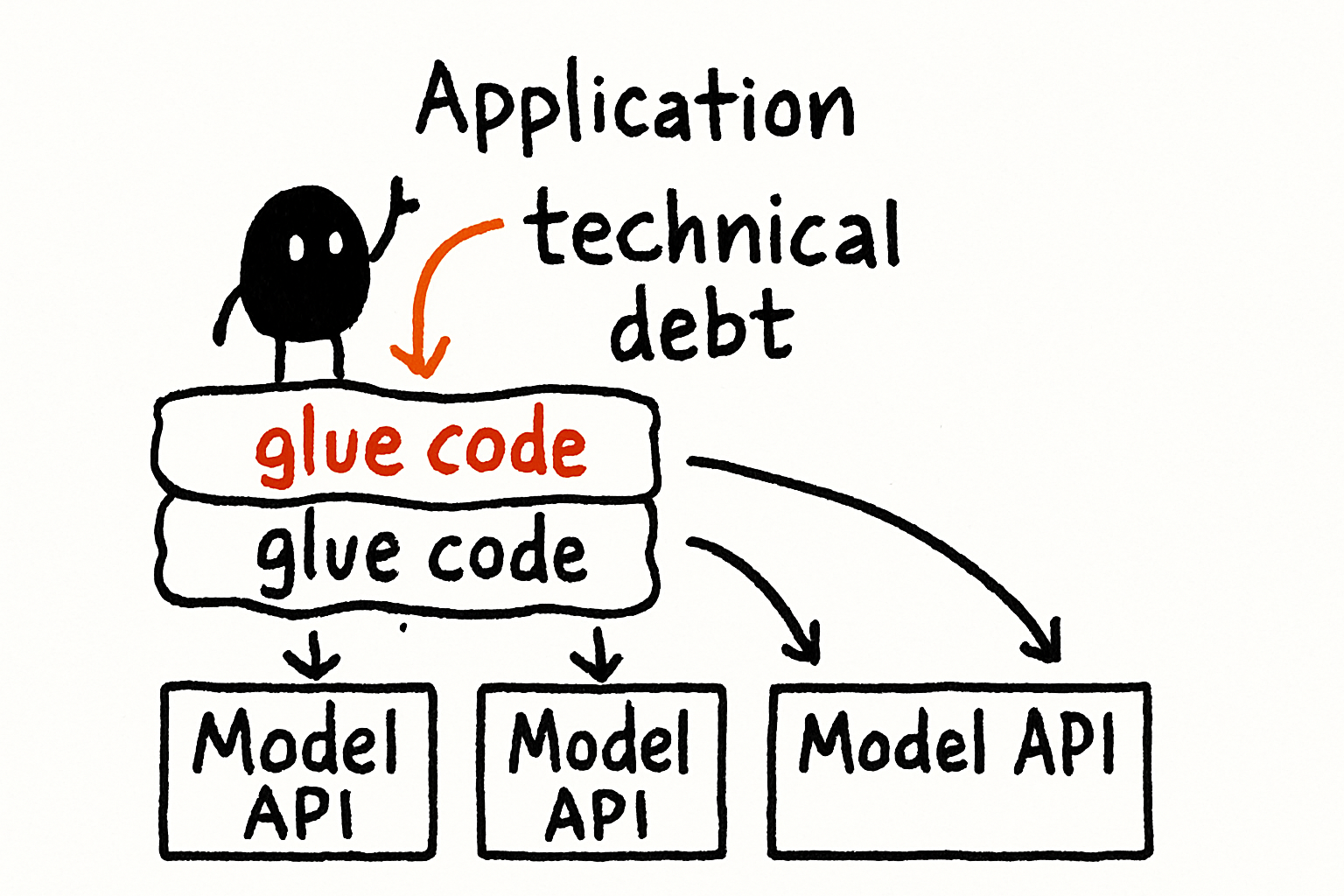
The hidden cost is not the migration. It is the lost velocity. Every time a model release breaks your system, you stop building features and start firefighting. Over a year, that cost dwarfs any API price difference.
How do I measure the cost of model churn in my system? Track the time spent per quarter on prompt re-tuning, evaluation re-runs, and agent logic fixes that correlate with model version changes. If that time exceeds 10% of your AI engineering capacity, you are paying a churn tax that model-agnostic infrastructure can eliminate.
H2: Context Engineering as the Abstraction Layer for Model Agnosticism
The solution is not to pick the “best” model and stick with it. The solution is to build an abstraction layer that decouples your application logic from the model’s internal behavior. That abstraction is context engineering.
Context engineering is the practice of structuring the input — the context window — in a way that is model-agnostic by design. Instead of tailoring prompts to a specific model’s instruction style, you define a canonical format for the context: a structured header with system constraints, a standardized schema for tool definitions, and a consistent output specification. The model is a black box that consumes this context and produces a response within the defined structure.
This works because modern models, despite their differences, share a common capability: they can follow structured instructions when the structure is clear and consistent. The key insight is that models are becoming more alike in their ability to parse well-defined formats, even as they diverge in reasoning depth and specialization. Context engineering exploits this convergence.
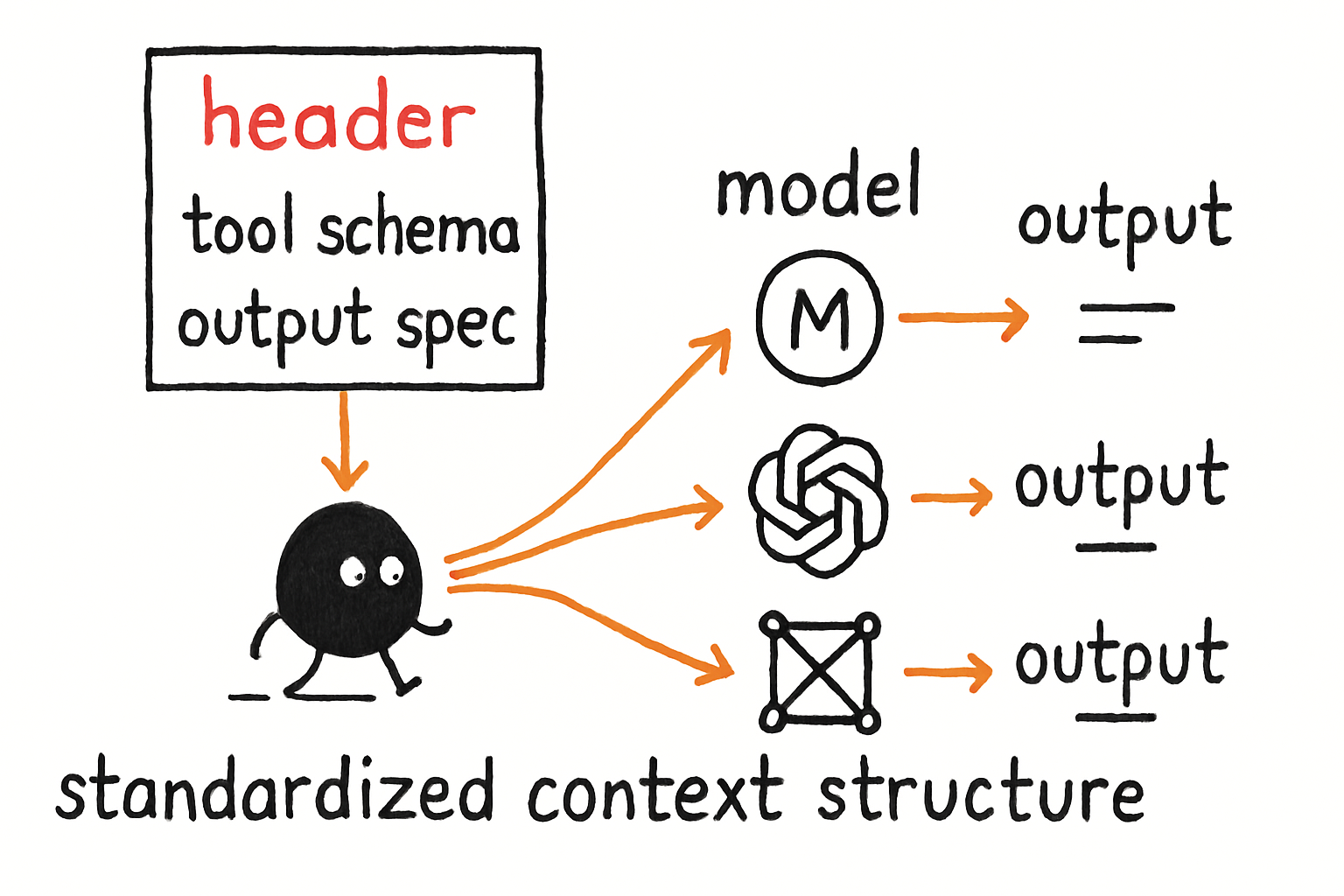
In practice, this means:
- Separate instruction from data. The system prompt should define behavior, not content. Content lives in a structured section of the context that the model treats as data to process, not instructions to follow.
- Use schema-driven tool definitions. Define tools in a format like JSON Schema that any model can parse, rather than relying on prompt tricks to force tool-calling behavior. Most frontier models now support native tool-calling APIs, but the schema approach works even with models that don’t.
- Enforce output structure via the context, not the model. Specify the output format as part of the context (e.g., “Respond with a JSON object containing fields: summary, confidence, next_action”). If the model deviates, the system can detect and retry, but the specification remains constant across model swaps.
H2: Practical Patterns for Building Model-Agnostic Agentic Systems
Agentic infrastructure — systems where models autonomously plan, use tools, and execute multi-step tasks — is especially vulnerable to model churn because the decision logic is deeply embedded in the model’s reasoning process. But the same principle applies: decouple the agent’s structure from the model’s behavior.
Here are the patterns I use in production.
Pattern 1: The Router Layer Do not hard-code which model an agent uses. Instead, build a lightweight router that selects a model based on task type, cost constraints, and latency requirements. The router is a simple classifier (can be a small model or even a rules engine) that maps tasks to model pools. When a new model outperforms the current one on a specific task, you update the router’s mapping — not the agent’s logic.
Pattern 2: Canonical Agent State An agent’s state — its current plan, completed steps, tool outputs, and pending decisions — should be stored in a model-agnostic format. I use a structured JSON schema that any model can read and write to. The agent prompt instructs the model to read the current state from the context, decide the next action, and output the updated state. The model is a state transformer, not a state owner. This makes it trivial to swap models mid-task.
Pattern 3: Output Validation as a Contract Do not trust the model to follow the output format. Build a validation layer that checks the model’s response against a schema. If it fails, you can retry with a clearer instruction or fall back to a different model. This validation is the contract between your system and the model. It does not change when the model changes.
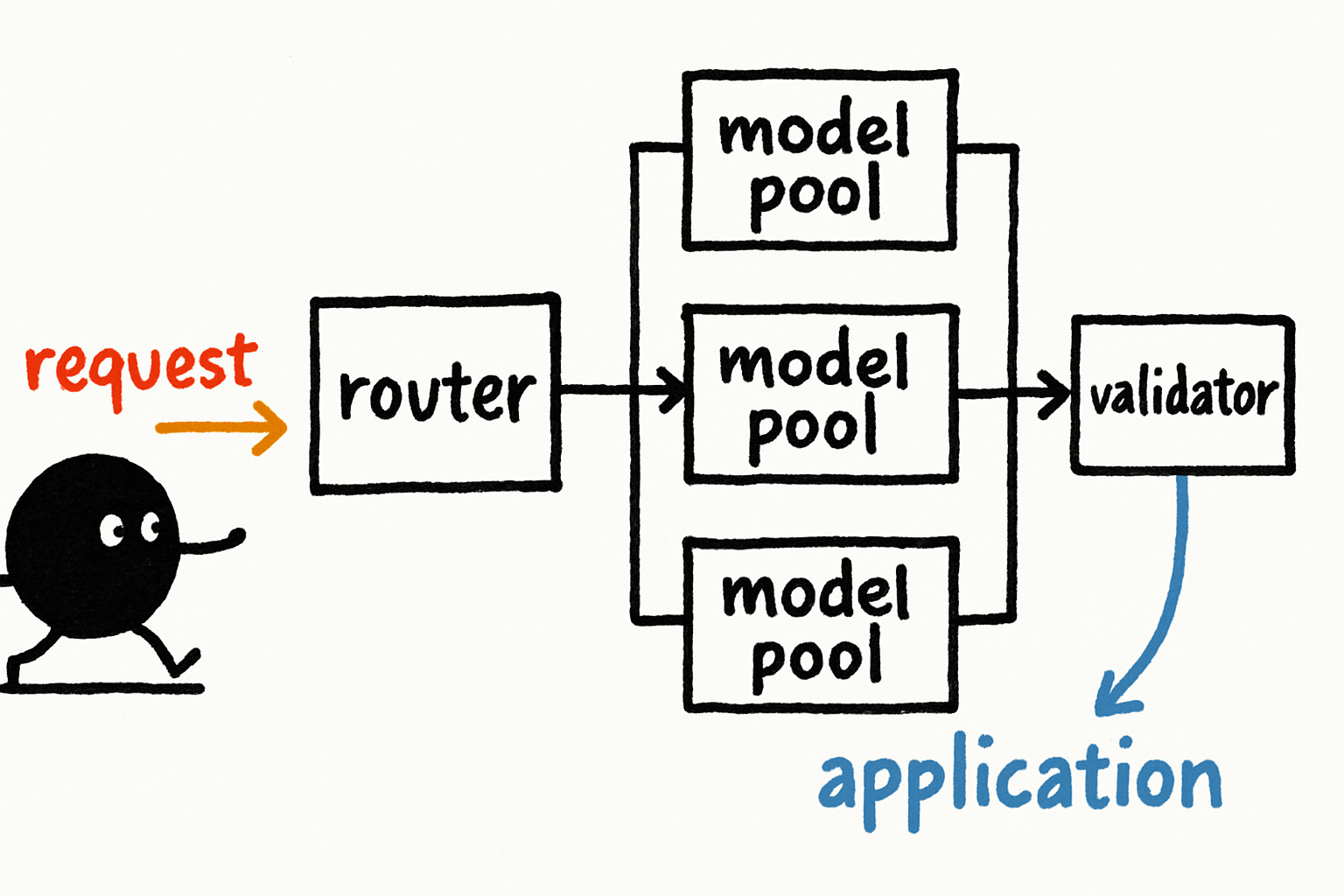
Pattern 4: Context Templates, Not Prompts Stop writing prompts. Write context templates. A context template is a parameterized document that includes system instructions, tool definitions, conversation history, and user input in a fixed structure. The model fills in the response slot. When you switch models, you do not rewrite the template — you might adjust the tone of the system instructions, but the structure remains identical.
The MIT Sloan explanation of agentic AI notes that true agentic systems require the ability to adapt to changing environments. Model churn is one of those environmental changes. An agent that cannot adapt to a new model is not an agent. It is a script.
H2: The Future: Infrastructure That Treats Models as Commodities
The long-term trajectory is clear. Models are becoming commodities. The differentiation will not come from which model you call, but from the infrastructure that surrounds it — the context engineering, the agent orchestration, the evaluation pipelines, the data management. The model is the engine. The infrastructure is the vehicle.
Nvidia’s recent push into agentic AI infrastructure, as reported by CIO, signals that even the hardware giants understand this shift. They are not just selling GPUs. They are selling the orchestration layer that makes models interchangeable. The industry is converging on the idea that the value is in the system, not the model.
My take
I have seen teams spend months optimizing prompts for a single model, only to have that model deprecated or surpassed. They treat it as an unavoidable cost of doing AI. I think that is a failure of engineering discipline. We would never build a web application that depends on a specific database query planner’s quirks. We abstract behind an ORM. We would never hard-code a specific cloud provider’s API into every service. We abstract behind a cloud-agnostic layer. Why do we treat models differently?
The answer is that the field is young, and the abstraction layers are immature. But they are emerging. Context engineering is the ORM for models. It is not perfect, and it requires discipline to maintain, but it is the only path to infrastructure that survives the firehose.
The teams that invest in model-agnostic patterns today will be the ones that ship features next year while their competitors are still re-tuning prompts for the latest release. The cost of model churn is not the API bill. It is the opportunity cost of being stuck in the past.
Key takeaways
- Model releases are accelerating, and the leaderboard churn is permanent. Betting on a single model is a losing strategy.
- Model-specific infrastructure creates hidden debt in prompt tuning, agent logic, and evaluation pipelines.
- Context engineering — structuring input in a model-agnostic format — is the abstraction layer that decouples your system from any single model.
- Agentic systems need a router layer, canonical state format, output validation, and context templates to survive model swaps.
- The future of AI infrastructure treats models as interchangeable commodities, with value concentrated in the orchestration and data layers.
- Invest in model-agnostic patterns now to avoid paying the churn tax every quarter.