You’ve built a RAG pipeline. You’ve chunked your PDFs, embedded them into Pinecone, and wired up a nice retrieve-then-generate flow. The demo looks smooth. Then you deploy it as an agent — one that has to book a refund, check inventory, and email a customer across three minutes of conversation. It fails. Not because the model is dumb, but because the context it retrieved is already wrong. The inventory just changed. The refund policy just updated. The customer just emailed a cancellation.
This is the moment most teams realize that retrieval augmented generation is not a real-time system. It’s a snapshot machine. And for agents that need to reason across steps, a snapshot is a liability.
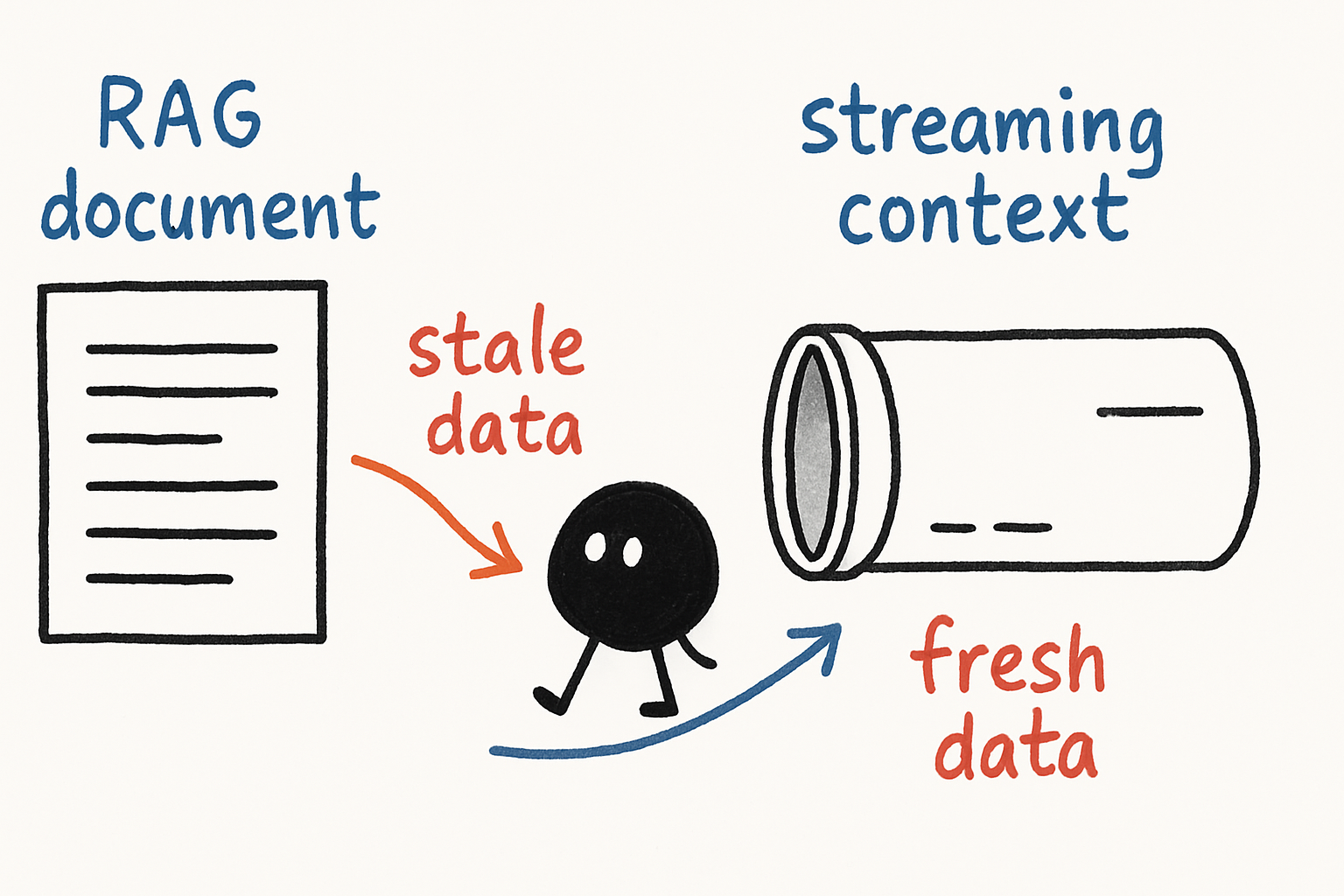
The RAG Fallacy in Agentic Workflows
RAG was designed for a simpler world: a user asks a question, you retrieve relevant chunks from a static corpus, and the LLM answers. It works great for FAQ bots, internal wikis, and knowledge base queries. But an agent is not a single-turn Q&A system. It’s a state machine that makes decisions, calls tools, and updates its understanding as new events arrive.
The core problem is that RAG treats context as a fixed snapshot. You embed a document at time T, store it, and retrieve it at time T+N. If the document changes in between — say a product price drops or a support policy is revised — the agent acts on stale information. This isn’t a latency issue; it’s an architectural mismatch.
Consider a customer support agent handling a refund. It retrieves the refund policy from a vector store, but the policy was updated 10 minutes ago. The agent tells the customer they’re eligible for a full refund, but the actual policy now only offers store credit. The customer is angry, the agent looks incompetent, and the whole loop breaks.
What is real-time context for AI agents?
Real-time context means the agent’s knowledge of the world is continuously updated from live data streams — APIs, databases, message queues, webhooks — rather than retrieved from a pre-indexed snapshot. It’s the difference between reading yesterday’s newspaper and watching the news feed.
This is not a minor optimization. It’s a fundamental shift from static retrieval to dynamic state management. And most agent frameworks today — LangChain, AutoGPT, CrewAI — still default to RAG for context, which is like building a self-driving car that only uses a map from last year.
Why Stale Context Breaks Multi-Step Reasoning
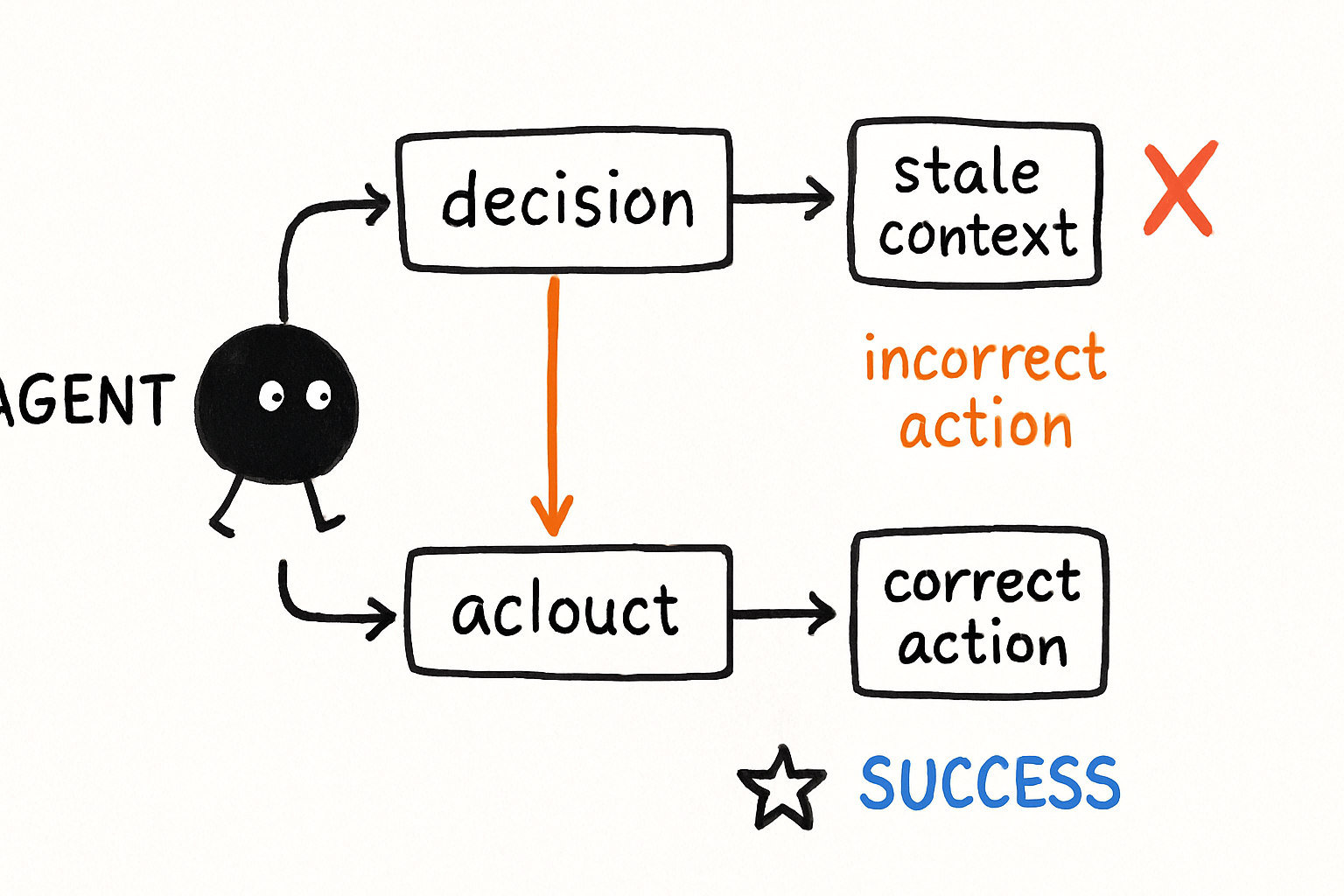
Multi-step reasoning is the killer feature of agents. The agent plans, acts, observes, and replans. Each step depends on the accuracy of the previous one. If the context is stale at step two, the entire chain collapses.
Take an inventory management agent. Step one: it checks stock levels and sees 50 units of SKU-123. Step two: it places an order for 10 units. Step three: it checks stock again — but the RAG context still says 50 units, even though the real database now shows 40. The agent thinks it has room to place another order, overcommits, and triggers a fulfillment error.
This is the classic “stale context drift” problem. The agent’s internal world model diverges from reality, and it keeps reasoning based on a fiction. The more steps the agent takes, the worse the drift gets.
Why does RAG fail for real-time agent applications?
RAG fails because it indexes documents at a fixed point in time and cannot incorporate live updates from streaming data sources like databases, APIs, or event buses. An agent that needs current inventory, pricing, or user state will act on outdated information, breaking multi-step workflows.
I’ve seen teams try to fix this by re-indexing every few seconds. That works for small datasets, but it’s expensive and misses the point. The agent doesn’t need a fresh snapshot of everything — it needs the specific, current value of the variables it’s acting on. Re-indexing the entire corpus is like refreshing your entire phone book every time one contact changes.
The real solution is not faster indexing. It’s a live context layer that pulls data on demand from authoritative sources and caches it intelligently.
Real-Time Context Engineering: A New Infrastructure Layer
Let’s call this what it is: context engineering. It’s the discipline of designing, building, and maintaining the live data streams that feed an agent’s reasoning loop. It sits between the agent framework and the data sources, and it’s the most overlooked piece of production agent infrastructure.
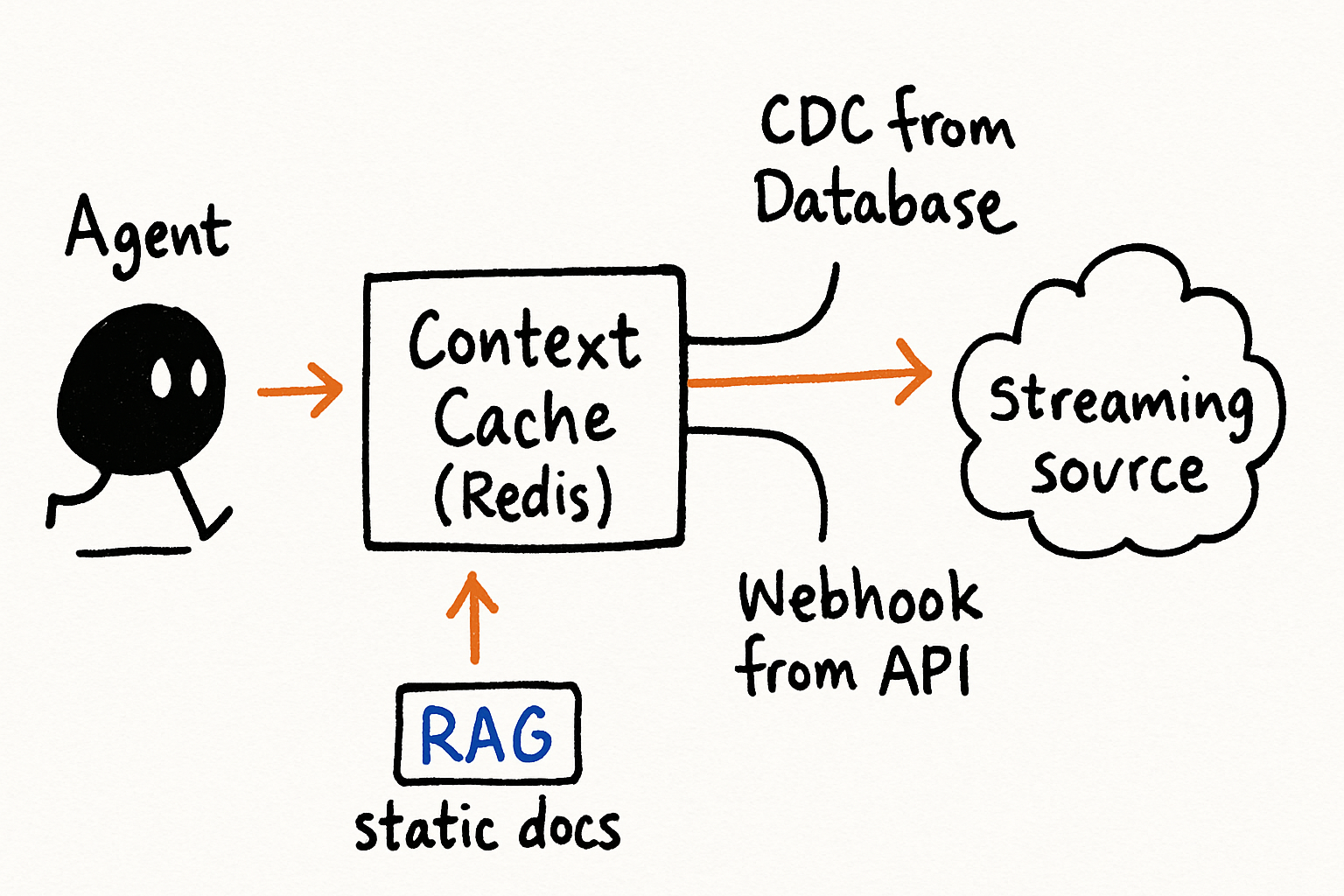
A live context layer has three responsibilities:
- Stream ingestion — Subscribe to data changes as they happen (database CDC, webhook events, message queue messages).
- On-demand resolution — When the agent needs a specific piece of information, resolve it from the live source, not a stale index.
- Context prioritization — Not all context is equal. The agent needs the most relevant and timely data, not a firehose of everything.
This is not theoretical. NVIDIA’s agentic AI stack explicitly includes a “context store” that’s separate from the vector database. As CIO reported, Nvidia stacks up agentic AI infrastructure with a focus on “real-time data orchestration” for agents. And OpenAI’s recent work on function calling and structured outputs is essentially a primitive version of this — giving agents live access to APIs rather than static documents.
The key insight is that context is not a document. It’s a state. A document is a static artifact. State is a live variable. When you treat context as state, you stop thinking about embedding and start thinking about streaming, caching, and invalidation.
My take
Here’s where I land: RAG is not dead. It’s fine for knowledge retrieval — answering “what did the CEO say in the last earnings call?” But if your agent needs to know the current temperature of a server, the latest order status, or the real-time price of a stock, RAG is the wrong tool. Engineers need to stop cargo-culting RAG into every agent architecture and start designing context pipelines that match the temporal dynamics of the data.
The hardest part is not the technology. It’s the mindset shift. Teams are comfortable with batch indexing. They’re not comfortable with streaming state management. But that’s where the real value is. An agent that acts on stale context is worse than no agent at all — it’s a liability.
Building a Live Context Pipeline: Streaming, Caching, and Prioritization
Let’s get practical. Here’s how you build a live context layer for an agent.
Step 1: Identify authoritative sources.
For each variable the agent needs (inventory count, user email, policy version), determine the single source of truth. Usually it’s a database, an API, or a message queue. Don’t replicate data into a vector store unless you absolutely have to.
Step 2: Stream changes into a context cache.
Use a change data capture (CDC) tool like Debezium or a webhook listener to push updates into an in-memory cache (Redis, Memcached, or even a local dictionary). The cache holds the latest value for each key. The agent reads from the cache, not the vector store.
Step 3: Implement on-demand resolution with fallback.
If a key is missing from the cache, the agent calls the source API directly. This ensures the agent always gets the freshest data when there’s no cached value. Cache TTL should be aggressive — seconds, not minutes.
Step 4: Prioritize context by recency and relevance.
Not every data point needs to be cached. Use a priority queue: high-frequency, high-impact variables (like inventory or pricing) get cached and streamed. Low-frequency, stable data (like company history) can stay in RAG. The agent’s planner should decide which context to fetch based on the current step.
Step 5: Invalidate aggressively.
If a source sends an update, immediately invalidate the cached value. Don’t wait for TTL. Use a pub/sub pattern where the cache subscribes to changes.
Case Study: A Customer Support Agent That Actually Works
I consulted on a project for a mid-size e-commerce company in the UK. They had a RAG-based support agent that answered questions from their help center articles. It worked fine for “How do I return an item?” But when they tried to extend it to handle refunds, cancellations, and order modifications, it fell apart.
The agent would tell customers they could cancel an order, but the order had already shipped. It would promise a refund amount based on a policy that had changed two hours ago. The support team spent more time cleaning up the agent’s mistakes than they saved.
We rebuilt the context layer. Instead of pulling from a vector store, we connected the agent directly to their order management system via a streaming API. When a customer asked about an order, the agent fetched the current status from the live system. When they asked about refund policy, we cached the latest policy version from a CMS webhook.
The result: the agent’s accuracy on multi-step workflows went from 62% to 94%. The support team could trust the agent to handle entire refund flows without human intervention. The key change was not a better model — it was live context.
How do you implement real-time context for AI agents?
You build a live context layer that streams updates from authoritative sources (databases, APIs, webhooks) into a cache, and resolve context on-demand rather than retrieving from a static index. Use CDC tools for database changes, webhooks for API updates, and prioritize high-frequency variables in the cache.
Conclusion: Context Engineering as the Missing Layer
The agent ecosystem is maturing fast. We have better models, better frameworks, and better orchestration. But the context problem remains the silent killer of production agents. RAG is a useful tool, but it’s not a context layer.
Real-time context for AI agents is the infrastructure that turns a brittle, snapshot-based agent into a robust, state-aware system. It’s the difference between an agent that guesses and an agent that knows.
The teams that invest in context engineering — streaming, caching, prioritization, invalidation — will build agents that actually work in production. The teams that keep bolting RAG onto everything will keep debugging stale context drift.
My advice: start with one data source. Pick a variable that changes frequently and matters to your agent. Stream it into a cache. Wire the agent to read from the cache. Measure the improvement in task completion rate. Then add the next source. You’ll never go back to pure RAG.
Key takeaways
- RAG is designed for static knowledge retrieval, not live state management — it fails in multi-step agent workflows.
- Stale context causes reasoning drift; each wrong step compounds the error.
- Real-time context engineering is a new infrastructure layer that streams, caches, and prioritizes live data.
- Build a context pipeline with CDC, webhooks, and an in-memory cache; invalidate aggressively.
- A live context layer improved a production support agent’s accuracy from 62% to 94%.
- Start small: one streaming source, one agent task, measure the delta.